

On-page SEO AI is changing how websites rank in search results. Instead of manually tweaking every element, AI tools handle keyword placement, meta tags, and content structure in minutes.
At Emplibot, we’ve seen firsthand how automation cuts optimization time by half while improving rankings faster. This guide shows you exactly how to implement these tools and what results to expect.
What On-Page SEO Actually Controls
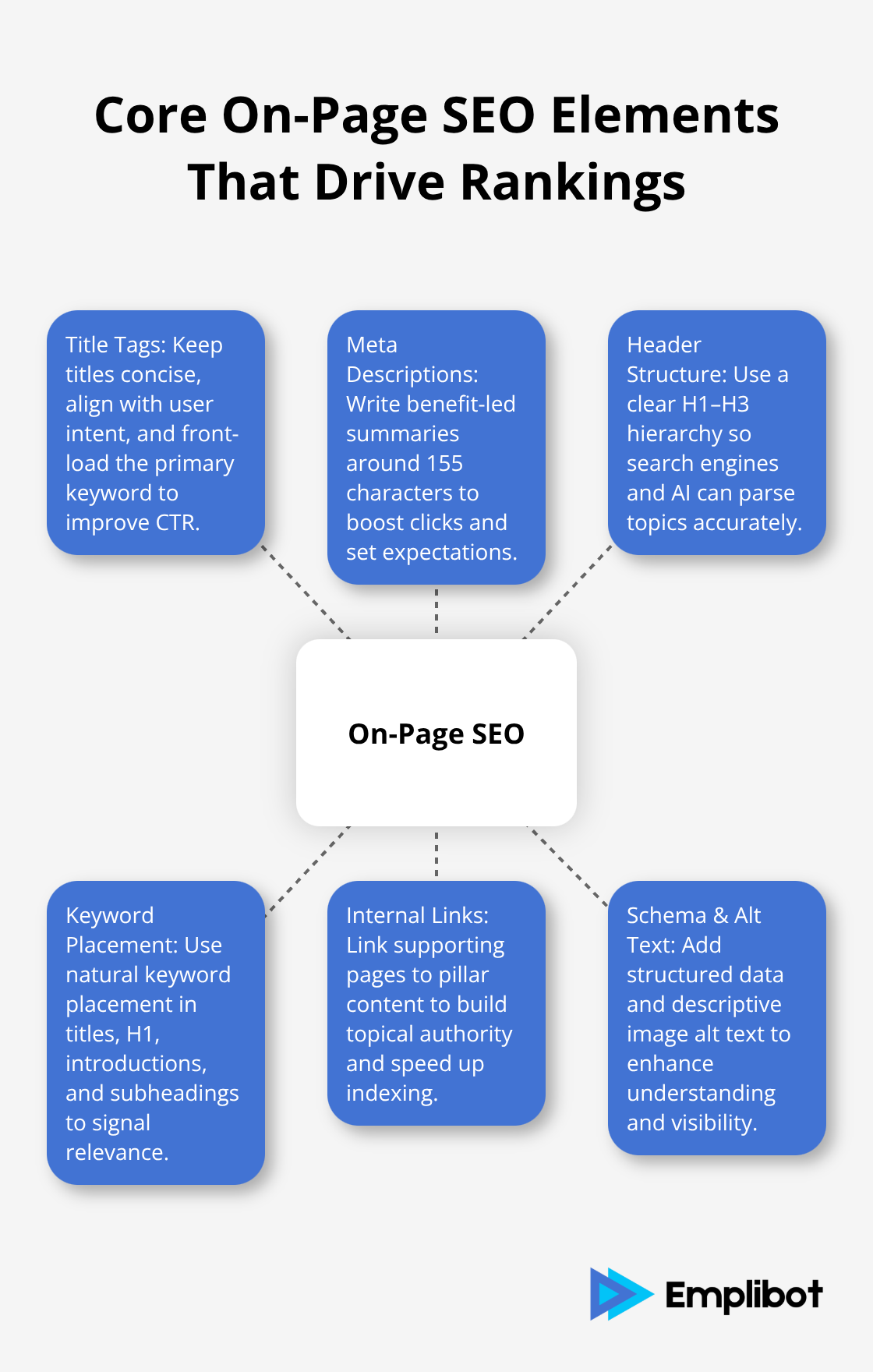
On-page SEO covers the elements you directly manage on your website to influence how search engines and AI systems understand your content. Title tags, meta descriptions, header structure, keyword placement, internal links, image alt text, and schema markup all fall into this category. These aren’t theoretical concepts-they’re measurable factors that determine whether your page gets indexed properly, ranks for the right searches, and appears in AI Overviews. Google’s algorithm now uses machine learning to evaluate content tone, user intent, and topic depth, which means poor on-page structure actively damages your visibility. The difference between a well-optimized page and a neglected one typically shows up within weeks, not months.
Organic traffic from search accounts for roughly 53% of all website visits across industries, so ignoring on-page optimization means leaving significant revenue on the table.
Why Rankings Depend on Getting These Details Right
Search engines crawl your pages and extract signals from title tags, headings, and body content to understand what you’re ranking for. A title tag that doesn’t match user intent loses clicks even if the page ranks-Seer Interactive found that being cited as a source in an AI Overview can lift click-through rate from 0.6% to 1.08%, but that only happens if your page is structured clearly enough for AI to parse. Mobile optimization now drives 62% of web traffic according to Statista’s Q4 2024 data, yet most sites still treat mobile as secondary.
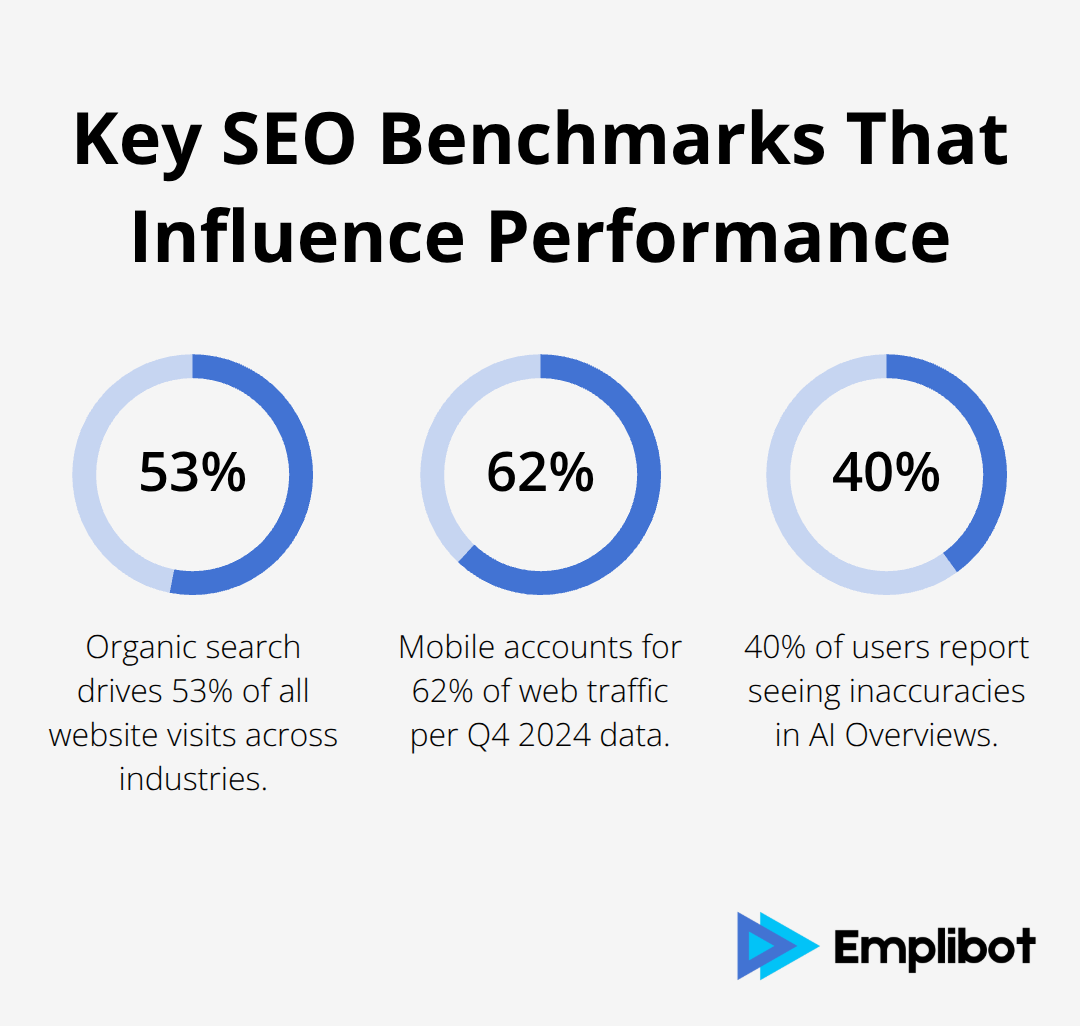
Core Web Vitals affect rankings directly, and pages with poor speed lose both search visibility and user engagement. The math is simple: faster pages rank higher, get more clicks, and convert better. Roughly 40% of users report seeing inaccurate content in AI Overviews, which means your on-page accuracy and source citations matter more than ever for credibility.
The Mistakes That Tank Your Rankings
Keyword stuffing, thin content, and poor internal linking remain the top killers of on-page performance. Many sites create duplicate or near-duplicate content across multiple pages, which confuses search engines about which page should rank. Meta descriptions under 155 characters with the primary keyword upfront improve CTR measurably, yet most businesses either skip them or write vague ones. Weak E-E-A-T signals (missing author credentials, unverified claims, and outdated information) now cost you rankings and AI citations. About 17% of Google’s top results contain AI-written content, but pages with poor editing and no human review tank quickly. Sites that ignore image optimization miss opportunities entirely; descriptive file names and alt text with natural keyword integration strengthen relevance without stuffing. The biggest mistake isn’t one tactical error-it’s treating on-page SEO as a one-time task instead of continuous improvement. Pages lose rankings when data becomes stale or competitors improve their content, which is why high-performing sites refresh their best pages every 6 to 12 months.
How AI Changes the Optimization Game
AI tools now handle the repetitive work that once consumed hours of manual effort. Automated keyword analysis identifies where to place terms for maximum impact, while content structure improvements happen in real time as you write. Schema markup generation, meta tag optimization, and internal linking suggestions all accelerate the process. This shift means you can focus on strategy and quality rather than tactical tweaks. The next section shows you exactly how to implement these tools and what results to expect from each one.
How AI Optimizes Every On-Page Element
Analyzing Your Pages Against Top Competitors
AI tools analyze your pages against top-ranking competitors and identify exactly where keywords should go, how headings should be structured, and what schema markup will help search engines understand your content faster. Tools like Surfer SEO crawl the top 10 results for your target keyword and show you the optimal word count, heading distribution, and keyword density to match user intent. This removes guesswork entirely. Instead of testing different keyword placements manually, AI calculates which positions in your title tag, H1, first paragraph, and subheadings will have the most impact on rankings.
Accelerating Results With AI-Assisted Optimization
AI-assisted optimization accelerates results when done correctly. The real power emerges when you combine AI recommendations with human judgment-agencies report 70% higher ROI from SEO when they use AI to handle data-heavy tasks while strategists focus on content quality and user experience. Mobile optimization becomes automatic too; AI tools flag slow pages, compressed images, and JavaScript that slows Core Web Vitals, then suggest exact fixes to improve Largest Contentful Paint and Cumulative Layout Shift.
Automating Metadata and Schema Markup
Title tags and meta descriptions get generated with your primary keyword positioned upfront, keeping titles under 60 characters and descriptions around 155 characters to maximize click-through rates in search results. Schema markup generation is where AI saves the most time-instead of manually writing JSON-LD code, AI tools detect your page type and automatically apply the correct schema, then test it with Google’s Rich Results Test.
Building Your Optimization Workflow
The workflow that works best starts with an AI site audit that identifies weak content, missing internal links, and pages losing traffic. Tools like Siteimprove scan your entire site in minutes and flag pages where metadata is missing, images lack alt text, or heading structure breaks readability standards. Next, you generate AI-backed content briefs that cluster related keywords by intent-informational, commercial, or navigational-so each page targets one primary keyword and covers subtopics naturally.
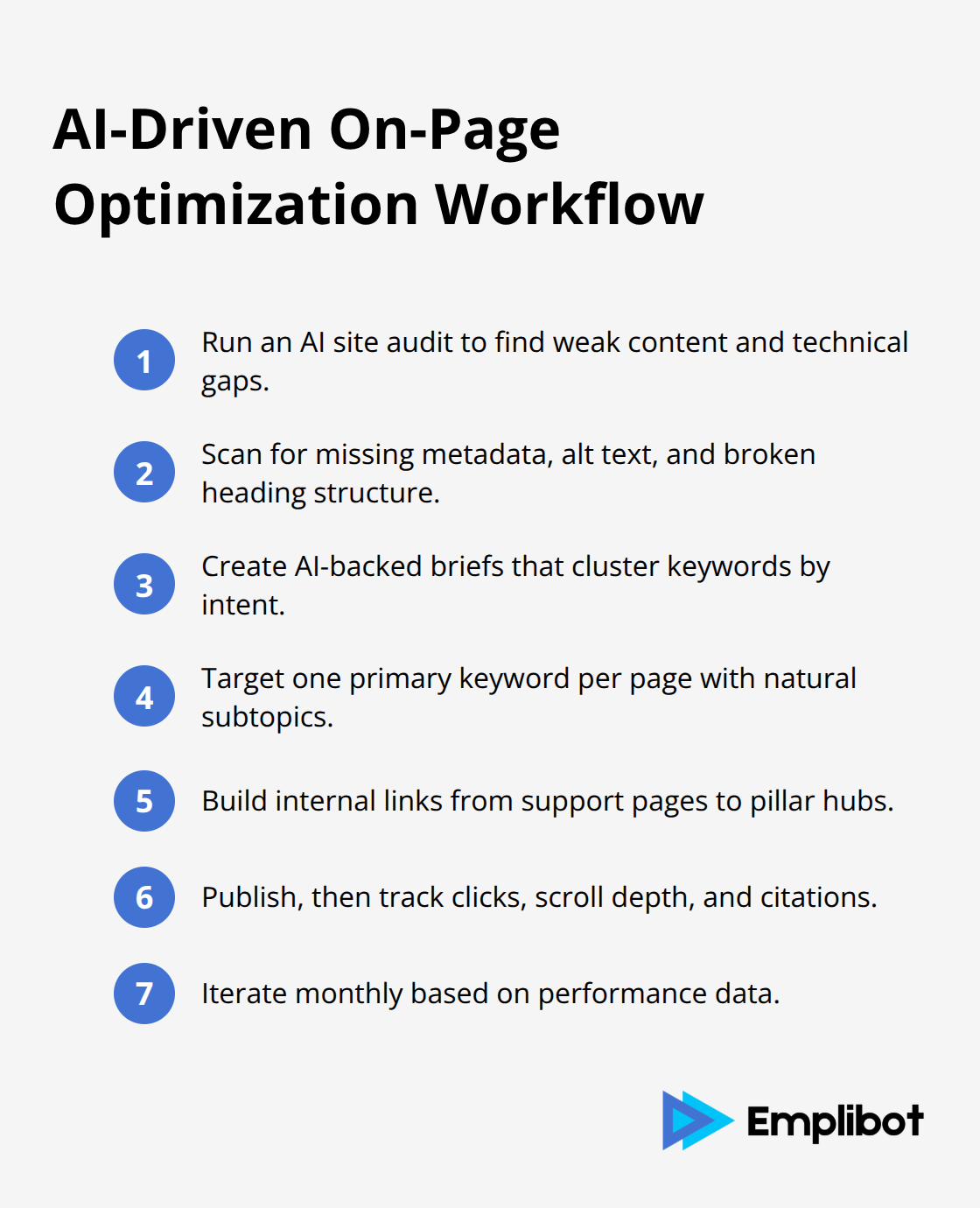
Internal linking recommendations then connect these pages strategically; AI identifies which pages should link to your pillar content and suggests anchor text that matches user intent. This matters because pages with strong internal linking structures rank faster and help Google understand your topical authority. After publishing optimized content, track performance with real-time dashboards that show which pages are gaining clicks, how scroll depth compares to competitors, and whether AI Overviews are citing your content. Roughly 88% of AI Overviews trigger informational intent according to Semrush, meaning educational content with clear structure and direct answers has the highest chance of appearing in AI summaries and driving traffic.
The automation handles repetitive tasks-keyword placement, metadata optimization, internal link suggestions-freeing your team to focus on what AI cannot replicate: original research, brand voice, and strategic content planning that aligns with business goals. This foundation of optimized pages and clear internal structure positions your site to capture traffic from both traditional search and AI-powered discovery channels, which leads directly into how you measure and sustain these gains over time.
Implement AI-Powered Optimization Without Wasting Time
Craft Title Tags and Meta Descriptions That Convert
Title tags and meta descriptions are where most sites leave traffic on the table. Google Search Console data shows that pages with titles under 55-60 characters and descriptions around 155 characters consistently outperform longer alternatives because they display fully in search results and reduce truncation. AI tools generate these automatically by placing your primary keyword at the start of the title, then filling the remaining space with benefit-driven language that matches user intent. Feed your target keyword and page topic into an AI optimizer and it produces 3–5 variations ranked by predicted click-through rate. Test each version in Search Console for two weeks, then keep the one that drives the highest CTR. This data-driven approach beats guessing every time.
Structure Headers to Signal Content Organization
Header structure matters equally for both search engines and AI systems that parse your content. Use one H1 per page containing your primary keyword, then break sections into H2 tags that cover subtopics naturally. H3 tags support specific points within those sections. This hierarchy helps AI understand your content’s organization and increases the chance of appearing in AI Overviews, where 88% of results target informational queries according to Semrush. Proper header structure also improves readability for human visitors, reducing bounce rates and increasing time on page.
Build Internal Links That Establish Authority
Internal linking is where most sites fail completely. Identify your pillar pages-the cornerstone content that covers broad topics comprehensively-then link relevant supporting pages to these hubs using descriptive anchor text and pillar page structure. A pillar page on digital marketing strategy might receive links from posts on email marketing, content calendars, and conversion optimization. This structure signals topical authority to Google and keeps users on your site longer, improving engagement metrics that influence rankings.
Monitor Performance With Real Data
Performance tracking separates serious optimization from busy work. Set up Google Search Console to monitor which keywords drive clicks, what your average CTR is for each query, and which pages lose impressions. Pages that rank in positions 5–15 but have low CTR are prime candidates for title tag rewrites-they’re close to breaking into the top three but fail to attract clicks. Refresh these titles using AI tools and monitor the impact weekly. Google Search Console also flags pages with indexing issues, crawl errors, and mobile usability problems that damage rankings directly.
Separately, use Google Analytics to track scroll depth, time on page, and conversion rates by landing page. Pages where users bounce immediately after arrival signal weak content-to-intent match, meaning your optimization missed what users actually wanted. Adjust your content structure and internal linking based on this behavioral data rather than assumptions. Core Web Vitals remain non-negotiable for rankings. Pages with poor Largest Contentful Paint, First Input Delay, or Cumulative Layout Shift lose visibility in mobile search results where 62% of traffic originates according to Statista’s Q4 2024 benchmark. Use PageSpeed Insights to identify specific bottlenecks-usually uncompressed images, render-blocking JavaScript, or missing caching headers-then fix them in order of impact. AI tools flag these issues automatically, but your developer must implement the fixes. Track improvements monthly because a single image optimization can lift your ranking position by 2–3 spots on competitive keywords.
Maintain Rankings Through Continuous Refresh
High-performing pages lose rankings when competitors improve their content or you stop updating data. Refresh your top 20 traffic-generating pages every 6–12 months by updating statistics, adding recent examples, strengthening internal links, and tightening weak sections. Request reindexing in Search Console after updates to signal freshness to Google’s crawlers. This maintenance approach costs far less than chasing new keywords while protecting the revenue your best pages already generate.
Final Thoughts
On-page SEO AI transforms how fast you optimize your site and measure real results. The tools handle keyword placement, metadata generation, and internal linking in minutes instead of hours, freeing your team to focus on strategy and content quality rather than repetitive work. Businesses using AI for SEO report 70% higher ROI, and pages optimized with AI assistance rank within two months on average.
Start today by running an AI site audit to identify weak content, missing metadata, and pages losing traffic. Generate title tags and meta descriptions for your top 20 traffic-generating pages using AI optimization tools, then test them in Google Search Console to measure click-through rate improvements. Track Core Web Vitals monthly because page speed directly impacts both rankings and user engagement.
Emplibot automates your WordPress blog and social media by handling keyword research, content creation, and on-page SEO AI optimization end-to-end. It produces high-quality content tailored to your business and distributes it across platforms, saving time while increasing traffic and leads. The combination of AI-powered optimization and strategic oversight delivers the fastest path to ranking improvements and sustainable organic growth.