

Keyword research used to mean hours spent in spreadsheets, guessing what your audience actually searched for. AI is changing that completely.
At Emplibot, we’ve seen how keyword research automation transforms SEO teams from manual researchers into strategic thinkers. Machine learning now identifies search patterns, understands user intent, and spots emerging opportunities in real time-work that once took days now happens in minutes.
How AI Actually Finds What People Search For
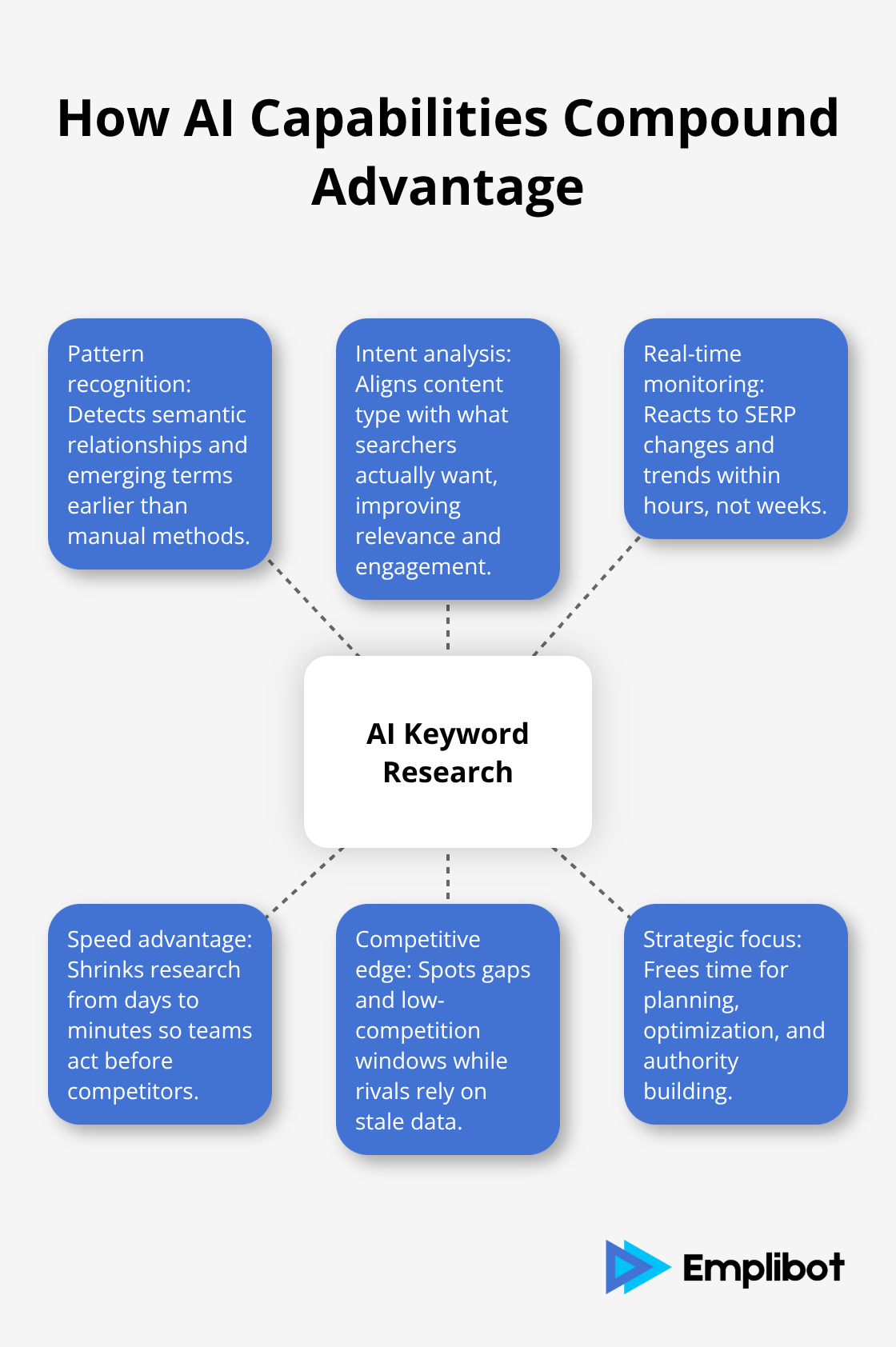
Machine learning algorithms process billions of search queries to identify patterns humans would never spot manually. Google processes 5.9 million searches per minute, creating massive datasets that AI analyzes in seconds rather than the weeks manual research once required. These algorithms recognize semantic relationships, search intent shifts, and seasonal demand changes before they become obvious. When you feed current SERP data into these systems, they surface which keywords drive clicks, which ones sit on page two with zero traffic, and which emerging terms gain momentum. The speed matters tremendously-a competitor launching content around a trending keyword today means you fall behind if your research process takes days.
What Intent Analysis Actually Changes
Natural language processing has fundamentally shifted how you understand what searchers actually want. Instead of assuming someone searching for product reviews wants to buy, NLP analyzes the full context (the words before and after the keyword, the page structure ranking highest, the questions appearing in People Also Ask sections). This means you stop creating generic content that ranks for keywords but attracts the wrong audience. When you target a keyword using intent-aware research, your content matches exactly what Google’s algorithm learned from millions of similar searches. Tools analyzing current top 10 results categorize each as informational, transactional, commercial, or navigational, letting you align your content type before writing a single word. This prevents the massive waste of creating beautiful blog posts optimized for keywords where searchers actually want product pages.
Real-Time Data Beats Yesterday’s Spreadsheets
Real-time analysis reveals opportunities competitors haven’t noticed because they still rely on monthly reports or quarterly keyword audits. Search trends shift constantly-what ranked well three months ago might be oversaturated now. AI systems continuously monitor SERP features, featured snippets, and People Also Ask questions to show you exactly which content types Google favors today, not last quarter. This agility matters for trending topics especially. When a news event creates sudden search volume around a topic, AI catches it within hours while traditional research processes remain in spreadsheet mode. You identify high-intent keywords with low competition windows before they close. Agencies using real-time SEO monitoring can react in minutes rather than days, meaning your team moves from drowning in data collection to actually strategizing around opportunities.
Why Automation Transforms Your Competitive Position
The real advantage emerges when you combine these three capabilities-pattern recognition, intent analysis, and real-time monitoring-into a single workflow. Your competitors still operate on yesterday’s data while you react to what searchers want right now. This speed advantage compounds over months. You spot emerging keywords weeks before they become competitive, you align content with actual user intent instead of guessing, and you adapt your strategy as search behavior evolves.
The next section explores how these capabilities translate into concrete benefits for your SEO team and your content strategy.
Practical Benefits of Automated Keyword Research
Automation eliminates the entire research phase as a bottleneck in your SEO workflow. Teams using AI-powered keyword tools cut their monthly research and analysis time from around 40 hours to just a few hours, according to data from SEO professionals tracking their workflows. That’s not a minor improvement. A single team member spending five days monthly on spreadsheets and manual competitor analysis suddenly has those hours available for strategy, content planning, or refining existing pages. The math becomes compelling when you multiply that across multiple team members or campaigns. If your agency manages ten client accounts and each previously required ten hours monthly for keyword discovery, you’ve freed up 100 hours. That translates to nearly three full-time weeks of capacity that can shift toward higher-impact work like optimizing underperforming content or building topical authority across priority topics.
Long-Tail Keywords That Competitors Miss Entirely
Long-tail keywords represent the biggest competitive advantage in automated research because AI systems surface variations and related terms that traditional methods miss. Machine learning analyzes search query patterns to identify semantic relationships-terms that mean similar things but appear in different combinations. A competitor researching the keyword “software for small business management” might miss “software to manage small business finances,” “accounting software for small business owners,” or “cloud-based business management tools.” These variations often have lower search volume individually but higher conversion intent and dramatically less competition. Keyword clustering tools organize these related terms into topic groups, revealing content opportunities that sit in plain sight within SERP data but require computational power to surface. Your team targets these gaps methodically instead of hoping to stumble across them. The efficiency multiplies when you realize that clusters often reveal 50 to 100+ related keywords from a single seed term, turning what once required hours of brainstorming into a structured opportunity map.
International Expansion Without Multiplying Research Hours
International expansion becomes realistic when keyword research automation handles the heavy lifting. Manual translation and localization of keyword research for multiple markets creates exponential work-researching keywords for five languages using traditional methods means five times the researcher hours. AI systems handle multilingual keyword discovery in the same timeframe as single-language research because the algorithms work identically across language datasets. You input your seed topics, and the system surfaces search volume, competition metrics, and intent data for German, French, Spanish, and Japanese simultaneously. Real-world implementation means your team identifies which markets offer the highest-volume, lowest-competition opportunities before investing in translation and localization. A software company exploring European expansion can run keyword analysis across ten countries in hours rather than weeks, determining which markets justify content investment based on actual search demand. This capability transforms international strategy from a gamble into a data-informed decision, where you allocate resources toward markets showing genuine search volume and lower saturation rather than guessing which regions matter.
These time savings and competitive advantages set the stage for the next critical question: which tools actually deliver these results, and how do you integrate them into your existing content workflow?
Which Tools Actually Deliver Automation Results
Semrush stands out as the most complete AI keyword research platform because it combines real-time SERP data, AI-generated keyword suggestions, and content optimization in one interface. The platform starts at $129.95 monthly with a seven-day free trial, and it delivers personalized metrics showing exactly how your domain could rank for specific keywords. When you input a seed topic like software for small business management, Semrush surfaces semantic variations, search volume, keyword difficulty scores, and intent classifications within seconds. Ahrefs offers stronger cross-platform capabilities if you need YouTube or Amazon keyword research alongside Google data, starting at $99 monthly, while Moz Pro delivers domain-level insights at $49 monthly with a 30-day free trial. The real decision point comes down to your workflow: Semrush works best for teams managing multiple campaigns who need centralized data, Ahrefs suits agencies requiring cross-channel analysis, and Moz Pro serves smaller teams or solopreneurs who prioritize affordability.
Embedding Research Into Your Writing Process
Surfer SEO takes a different approach that eliminates the separation between research and content creation. The platform embeds keyword optimization directly into your writing process rather than treating research as a separate phase, starting at $89 monthly with a seven-day refund window. You research keywords, see current SERP data, and optimize as you write without leaving the editor. This matters because it removes tool-switching between keyword research and content creation. WriterZen offers budget-friendly clustering at $19 monthly with a seven-day trial, focusing specifically on topic clustering and AI-generated keywords for teams just starting with automation.
Building a Two-Phase Workflow That Actually Works
Integration into your content workflow determines whether you actually use these tools or let them sit unused. The most effective approach separates keyword research into two distinct phases: discovery and optimization. In discovery, you spend 30 minutes monthly running your seed topics through your chosen platform, export the keyword clusters, and build a content calendar organized by topic rather than individual keywords. This replaces the weeks teams once spent manually mapping keywords to pages. In optimization, you import the top keywords and SERP data into your editor, whether that’s Surfer SEO’s built-in optimization or a spreadsheet you reference while writing.
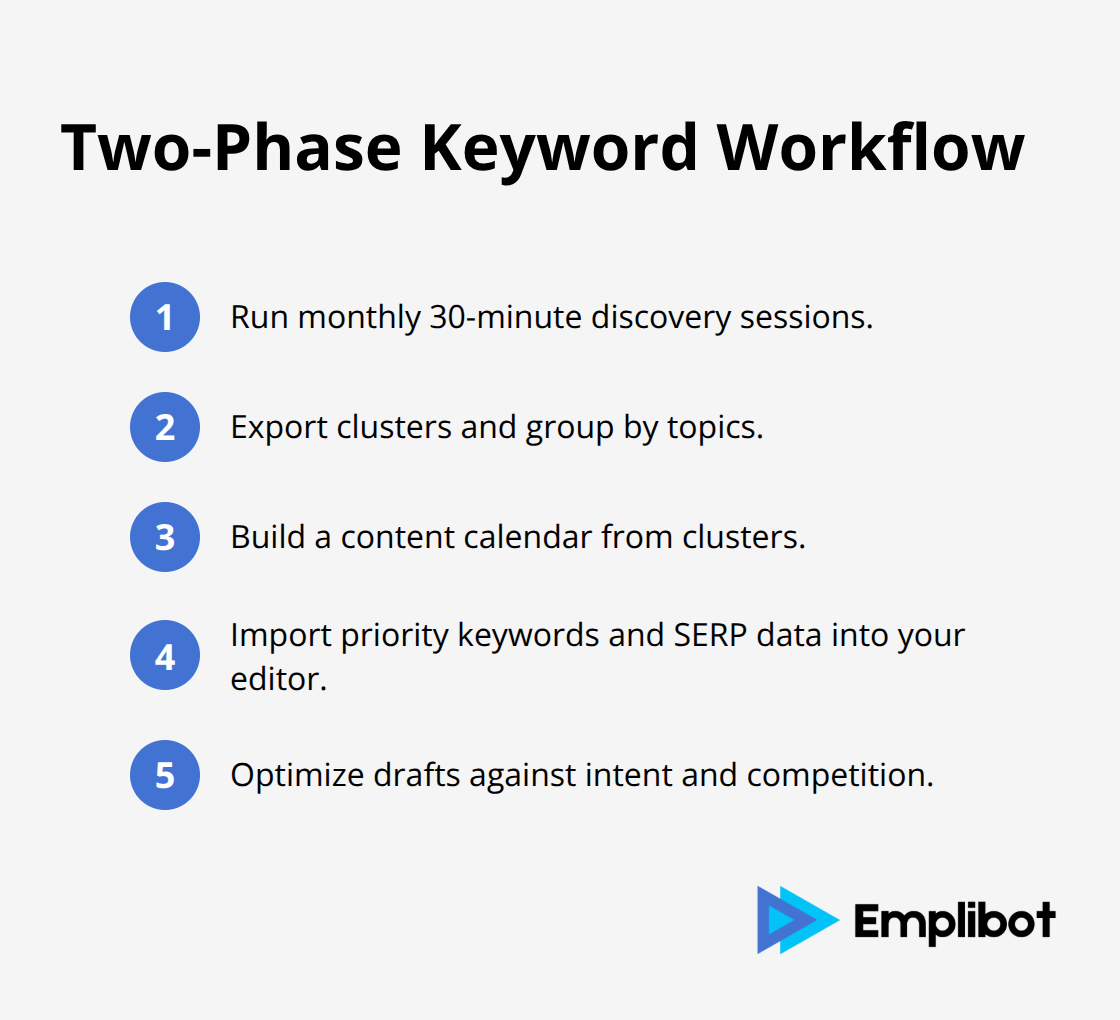
This two-phase workflow prevents the common failure where teams collect beautiful keyword data that nobody actually uses.
Tracking ROI With the Right Metrics
Measuring ROI requires tracking three metrics: time saved versus your previous research process, organic traffic growth from newly targeted keywords, and conversion rates from different keyword intent categories. Calculate your monthly researcher hours before automation, subtract your current hours spent on keyword research, and multiply by your fully-loaded hourly cost.
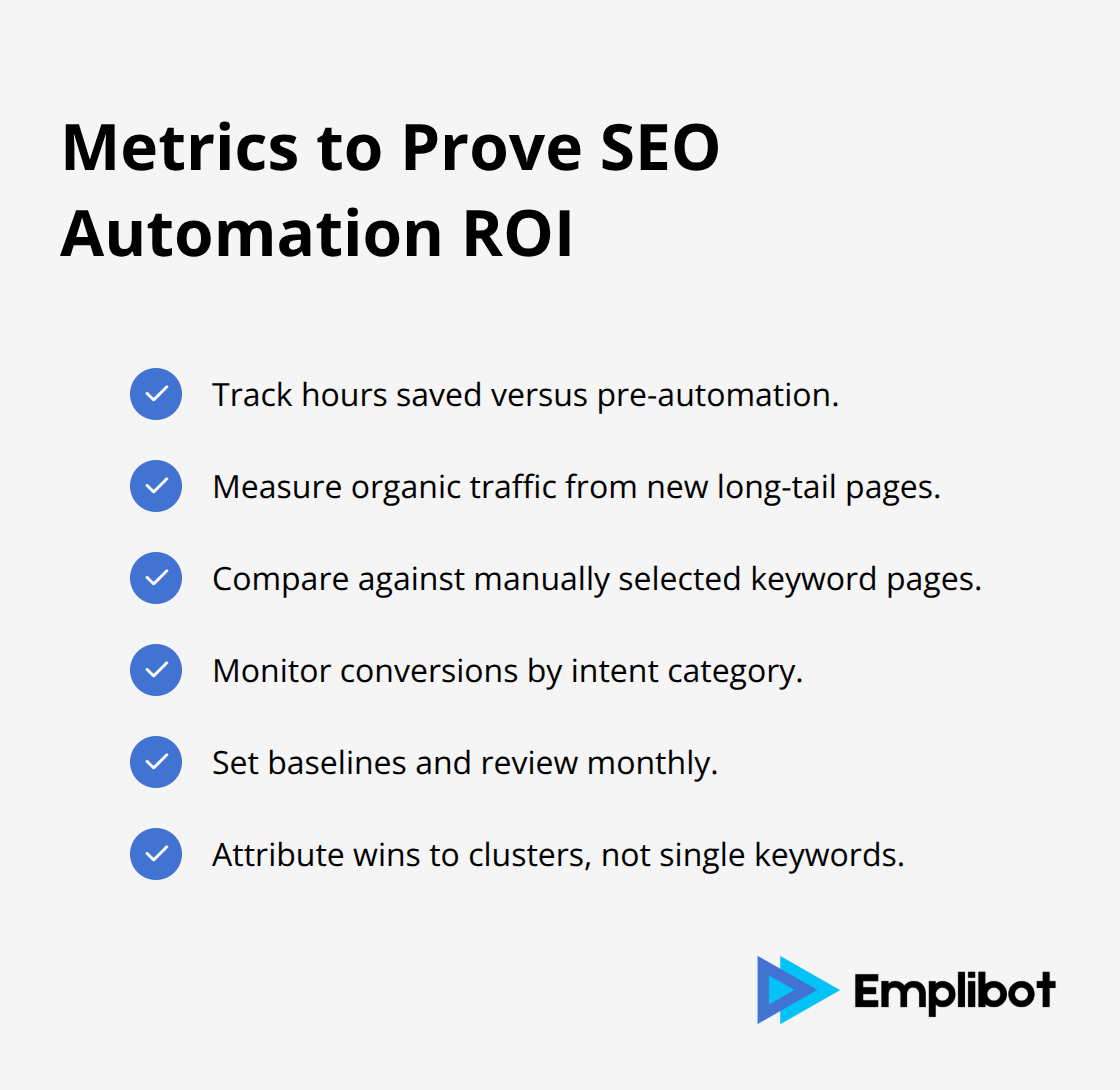
Most teams see ROI within three months as freed-up capacity translates to more content published or better optimization of existing pages. Traffic measurement matters more than keyword rankings because ranking position means nothing if your keyword attracts the wrong audience. Compare organic traffic from pages targeting long-tail keywords your automation surfaced against traffic from pages targeting keywords your team previously chose manually. Conversion tracking reveals whether intent analysis actually improved quality, showing which keyword clusters drive leads versus which ones drive vanity metrics. Set baseline metrics before implementing automation, then measure monthly to prove the value to stakeholders who question subscription costs.
Final Thoughts
Keyword research automation fundamentally changes how SEO teams operate. Instead of spending weeks in spreadsheets, you now access real-time data revealing exactly what people search for, when they search, and how competitive each opportunity actually is. This shift from manual research to strategic thinking compounds over time as your team stops drowning in data collection and starts making decisions based on patterns that would take humans months to identify.
The competitive advantage emerges when speed and precision work together. While competitors still rely on monthly reports, you react to emerging keywords within hours. While they create content hoping it matches user intent, you align every piece with actual search behavior. Teams using keyword research automation report freeing up 40 hours monthly previously spent on manual analysis, capacity that redirects toward strategy and optimization (this time advantage multiplies across campaigns and team members, creating a compounding effect where your organization simply moves faster than competitors still operating on yesterday’s data).
AI handles the computational heavy lifting, but humans provide the strategic direction. You decide which markets matter, which topics align with your business goals, and how to structure content for maximum impact. Emplibot automates your entire content workflow from keyword research through SEO optimization and distribution, handling the research and creation phases that consume most teams’ resources.