

SEO rankings don’t stay static anymore. Search algorithms evolve constantly, and manual optimization can’t keep pace with the speed required to stay competitive.
At Emplibot, we’ve seen firsthand how AI for SEO strategies is fundamentally changing how teams approach ranking improvements. The tools that worked last year are already becoming outdated, which means your playbook needs to shift too.
How AI Reshapes Keyword Research and Content Optimization
AI fundamentally changes how you identify ranking opportunities and close content gaps. Traditional keyword research relies on guesswork and historical data, but AI-powered tools analyze search patterns at scale in minutes. Semrush One tracks over 100 million prompts across ChatGPT, Perplexity, Google AI Mode, and AI Overviews across six regions, revealing where your audience actually searches. This visibility matters because AI search traffic rose 527% year-over-year from January to May 2024 compared to the same period in 2025. If you’re still optimizing only for Google’s traditional search results, you’re missing more than half your potential visibility.
AI-Driven Keyword Research Uncovers High-Intent Opportunities
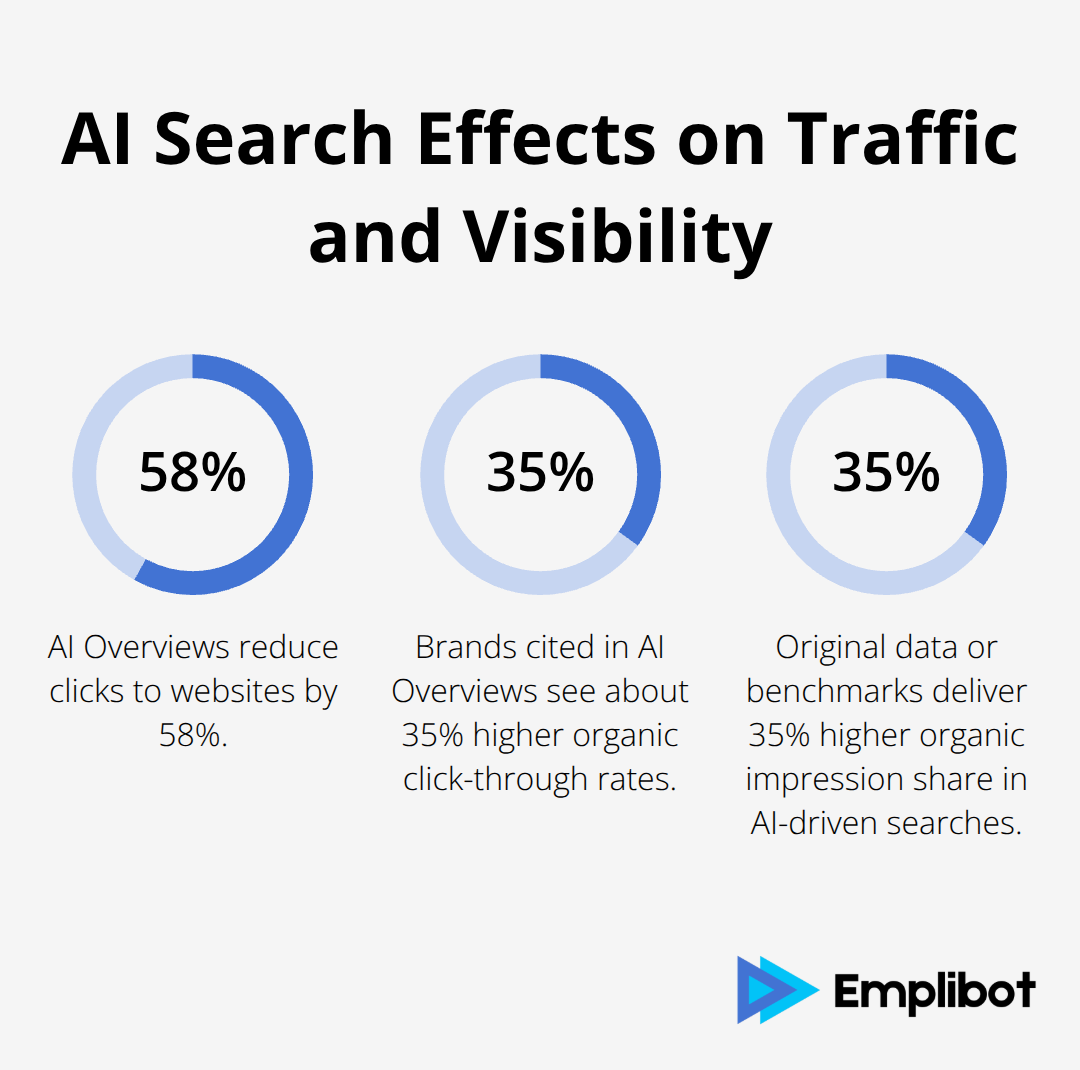
AI-powered keyword research uncovers high-intent terms by analyzing user behavior patterns that humans would take weeks to spot manually. Tools like Ahrefs and SEMrush use machine learning to identify long-tail keywords with conversion potential, clustering related terms into semantic groups that reflect how real people search. Content pieces with original data or benchmarks achieve 35% higher organic impression share in AI-driven searches across 40+ B2B SaaS accounts, which means AI helps you understand what information actually matters to your audience.
Real-Time Monitoring Catches Opportunities Before Competitors
Real-time performance monitoring through AI agents like Semrush Copilot delivers daily, personalized recommendations on technical issues, keyword opportunities, competitor moves, lost backlinks, and traffic drops-changes you’d normally discover weeks later through manual analysis. This speed advantage compounds over time, allowing you to respond to market shifts faster than teams relying on weekly reports.
Content Optimization Stops Being Guesswork
Content optimization stops being guesswork when AI analyzes SERP data and measures your gap against top-ranking competitors. Surfer SEO’s Content Editor tracks your content score in real-time, and articles scoring 75 or higher tend to rank in the top 20 within about 30 days based on their testing. This correlation between score and ranking gives you a concrete target instead of hoping your content is good enough.
AI identifies missing subtopics, semantic gaps, and structural improvements that humans overlook. When you generate long-form drafts with tools like Surfer AI or Koala AI, you’re not replacing your expertise-you’re eliminating the blank-page problem. Koala AI produces 1,000–3,500+ word outputs with customizable tone, outline, and language settings, allowing you to scale content production while maintaining brand voice.
Balance AI Drafting With Human Strategic Input
The real advantage comes from combining AI drafting with human strategic input. Content gaps exist where user questions go unanswered, and AI excels at extracting those questions from Google, Reddit, and Quora through tools like Frase’s Answer Engine. You then prioritize which gaps matter most for your business, not every gap AI identifies. This balance between automation and human judgment separates teams that rank from teams that waste time optimizing irrelevant topics.
Your next challenge isn’t just finding these opportunities-it’s implementing them at scale without burning out your team. The tools that make this possible require a different approach to your entire workflow.
Which AI Tools Actually Deliver Results for SEO
Semrush One stands out as the strongest all-in-one platform because it combines keyword research, site audits, and competitor analysis with real-time tracking across AI search platforms. The AI Visibility Toolkit tracks brand mentions, sentiment, and share of voice against up to nine competitors across ChatGPT, Google AI Mode, and other platforms, giving you visibility into where your audience actually discovers content. Personal Keyword Difficulty scores your domain specifically rather than using generic metrics, so you target keywords you can realistically rank for instead of chasing inflated difficulty numbers. For pure on-page optimization, Surfer SEO’s real-time Content Editor outperforms competitors because it correlates content scores directly to rankings. Their data shows articles scoring 75 or higher rank in the top 20 within 30 days, which gives you a measurable target. Surfer AI generates long-form drafts exceeding 2,000 words and supports 15+ languages, meaning agencies producing high-volume content can scale without sacrificing quality. Ahrefs remains the benchmark for backlink analysis because their index refreshes every 15–30 minutes, the fastest in the industry, and their free Webmaster Tools add value for verified site owners without additional cost.
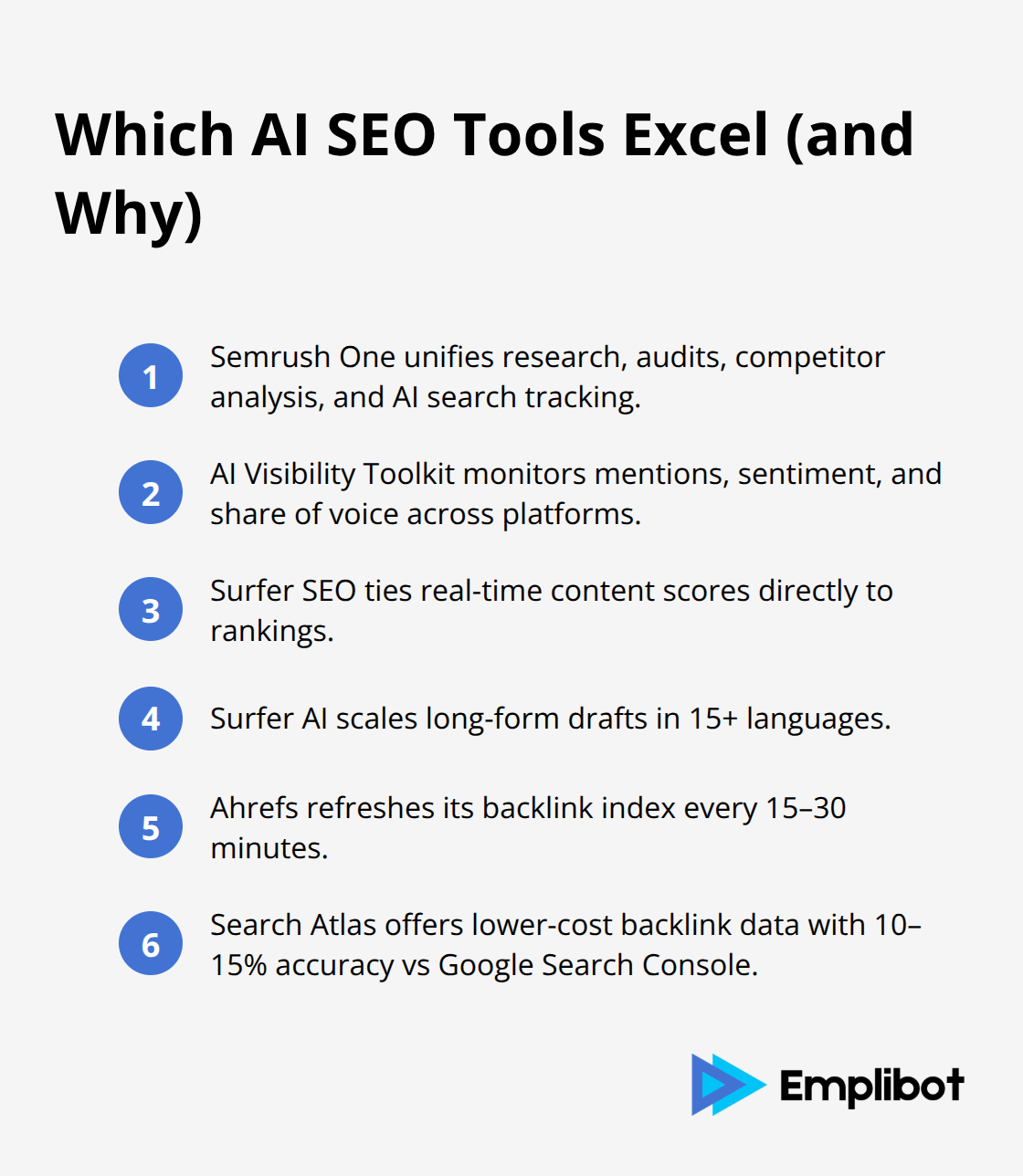
For agencies working with tight budgets, Search Atlas offers comparable backlink data at roughly half the cost of enterprise platforms like Ahrefs or Semrush, with accuracy typically within 10–15% of Google Search Console data.
Content Generation Requires Guardrails, Not Just Speed
Koala AI produces 1,000–3,500+ word outputs with customizable tone, outline, and language settings, allowing you to scale drafts quickly. The tool gives you 5,000 free words monthly to test before you commit to paid tiers starting at $9. ChatGPT Plus at $20 monthly handles outlines, meta descriptions, and data analysis efficiently, though it lacks built-in rank tracking and site audits, so you’ll pair it with separate tools. Frase excels at rapid content briefs by aggregating questions from Google, Reddit, and Quora through its Answer Engine, but it lacks rank tracking and CMS integration, making it ideal for research-heavy workflows rather than end-to-end automation. Most teams treat AI-generated content as finished work, which is a critical mistake. Content with original data achieves significantly higher organic traffic increases compared to generic AI drafts, which means original insights matter in AI-driven searches. Plan 30–45 minutes of editing per piece to inject original insights, remove hallucinated claims, and align output with your brand voice. Brands cited in AI Overviews see about 35% higher organic click-through rates, so the goal is getting mentioned in AI results, not just ranking in traditional search.
Automation Works When You Automate the Right Tasks
Semrush Copilot delivers daily personalized recommendations on technical issues, keyword opportunities, competitor moves, and traffic drops, eliminating the manual work of weekly reporting. SE Ranking offers 100+ search engine tracking and automated weekly reports starting at budget-friendly pricing, making it practical for agencies managing multiple clients without expensive tools. Rankability specializes in ongoing content quality monitoring with a rankability score predicting top-20 potential within 30–45 days, helping you identify which existing content deserves optimization investment versus which pieces should be archived. Smartlead automates link-building outreach with unlimited email accounts, AI-driven warmup sequences, and dynamic IP rotation, though you’ll need supplemental email-finder tools to maximize prospecting efficiency. The teams that win automate repetitive identification and data collection tasks while keeping human strategists focused on deciding what to optimize and why, not executing manual work that scales linearly with team size. This distinction between what you automate and what you control strategically determines whether AI tools accelerate your SEO or create busywork that wastes resources.
Where AI Content Goes Wrong
AI-generated content that ranks poorly typically fails because teams treat the output as finished work instead of a starting point requiring human judgment. When you publish AI drafts without verification, hallucinated facts slip through-AI models confidently invent statistics, misquote sources, or create plausible-sounding claims that don’t exist. A piece claiming that 73% of marketers use AI for SEO sounds authoritative until someone fact-checks it and finds no supporting research.
These errors damage credibility permanently, especially in competitive niches where accuracy determines whether readers trust your insights. The solution isn’t abandoning AI drafting; it’s treating AI output as a rough foundation that demands human review before publication. Fact-check every statistic against original sources, verify that cited studies actually exist, and test claims against your own data.
Verification Prevents Credibility Collapse
This overhead costs time upfront but prevents the much larger cost of publishing misinformation that tanks your domain authority later. Your fact-checking process should flag any statistic without a source, any study without a publication date, and any claim that contradicts your internal data. Most AI models generate confident-sounding numbers that sound real but lack any basis in actual research. You catch these errors before publication, not after readers spot them on social media or in comments.
AI Misses What Your Audience Actually Needs
AI optimizes for keyword density and SERP patterns, not for solving the specific problems your audience faces. A tool like Surfer SEO might tell you to add 15 more semantic variations of your target keyword, but if those variations don’t answer real customer questions, the content ranks without converting. Your sales team knows which objections block deals, which features confuse prospects, and which competitor claims require direct rebuttal-information that AI never encounters.
The gap widens when you optimize for AI search platforms without understanding user intent. AI Overviews reduce clicks to websites by 58%, meaning you need content that AI systems cite directly rather than content that ranks well in traditional search alone. This requires original research, unique frameworks, and proprietary data that AI cannot generate. Brands cited in AI Overviews see about 35% higher organic click-through rates, which proves that being mentioned matters more than ranking position.
Test content in AI search tools before publishing and adjust based on whether AI systems actually cite your work. This means building your content strategy around what your audience actually searches for in ChatGPT and Perplexity, not just what keywords have search volume.
Automation Breaks When You Automate Everything
Teams that automate 100% of their SEO workflow without human oversight typically see diminishing returns within three months. Automated rank tracking reports show you rankings, but they don’t tell you why a competitor suddenly outranked you or whether that drop matters for your business goals. Automated content scheduling publishes consistently but ignores seasonal shifts in search intent or competitive moves that demand immediate response.
Semrush Copilot delivers daily recommendations on technical issues and keyword opportunities, but the tool flags hundreds of potential optimizations monthly-most of which won’t move your rankings. Your job is filtering what actually matters for your business, not executing every suggestion the tool generates.
Strategic Control Separates Winners From Wasters
The most effective approach separates what you automate from what you control strategically. Automate the data collection phase so your team sees opportunities without manual research work. Keep the decision phase human: deciding which opportunities align with your business, which content deserves investment, and which competitor moves require response (this balance prevents wasting resources on optimizations that don’t drive revenue while maintaining the speed advantage that AI tools provide).
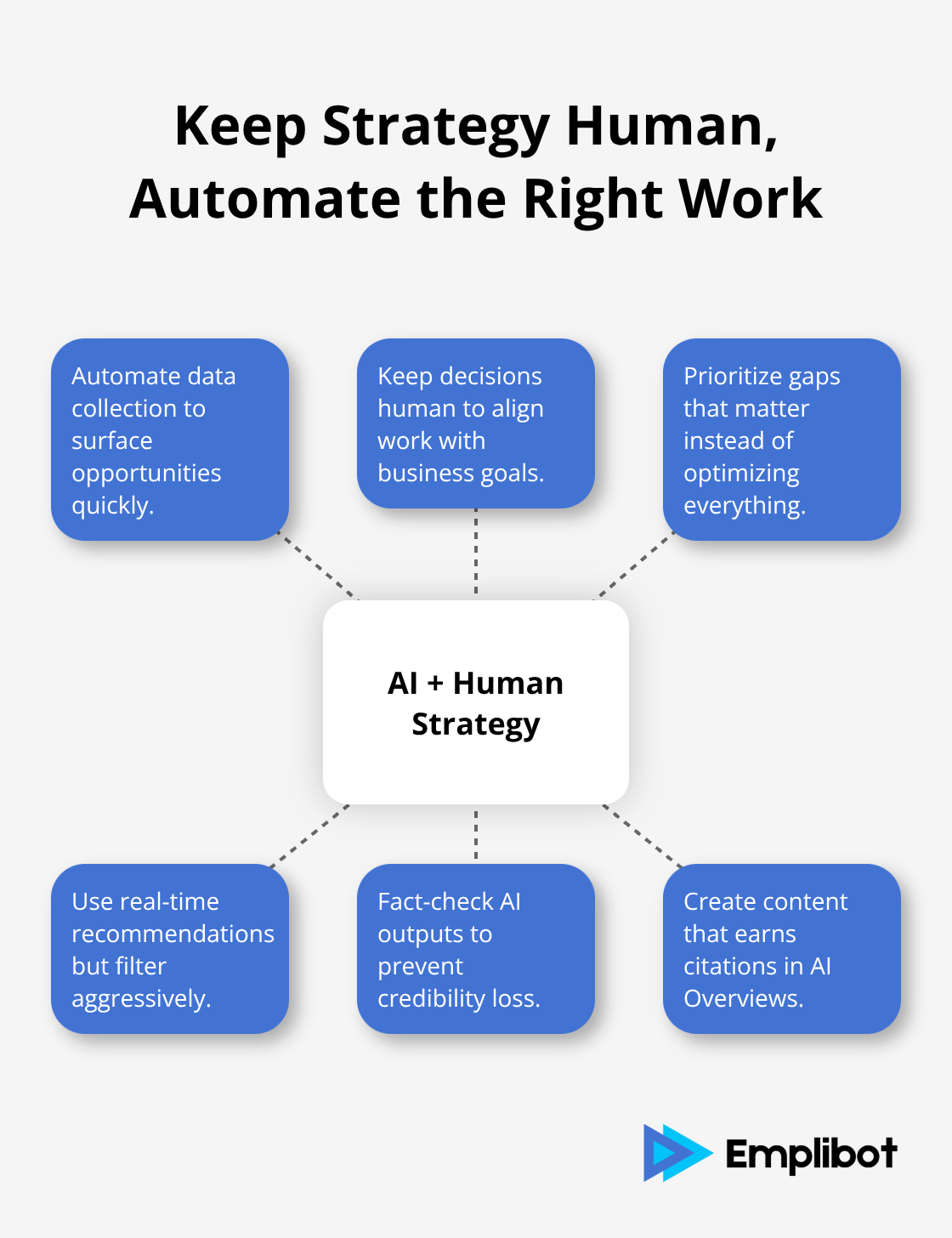
Human strategists should focus on deciding what to optimize and why, not executing manual work that scales linearly with team size. This distinction determines whether AI tools accelerate your SEO or create busywork that wastes resources.
Final Thoughts
AI for SEO strategies isn’t a trend that will fade when the next marketing buzzword emerges. The 527% year-over-year increase in AI search traffic proves that your audience already searches through ChatGPT, Perplexity, and Google AI Mode, and teams that ignore this shift will watch their visibility collapse as traditional search traffic continues declining. The question isn’t whether to adopt AI tools for SEO-it’s how to implement them without sacrificing the strategic thinking that separates winners from competitors chasing every optimization suggestion. Treat AI as a force multiplier for human expertise, not a replacement for it.
Semrush Copilot flags technical issues and keyword opportunities daily, but your strategists decide which ones matter for your business. Surfer SEO tells you that your content needs a higher score, but you determine whether that topic actually converts prospects into customers. Automate the repetitive work of data collection and opportunity identification, then keep the decisions about what to optimize and why firmly in human hands.
Start small if you’re new to AI for SEO strategies by testing one tool in your workflow this month-whether that’s Semrush One for keyword research, Surfer SEO for content optimization, or Ahrefs for backlink analysis. Emplibot automates your WordPress blog and social media by managing everything from research to publishing, freeing your team to focus on what AI can’t do-understanding your customers and deciding what content actually moves your business forward. The teams that thrive in 2026 won’t be the ones with the most tools; they’ll be the ones who know exactly which tools solve their specific problems.