

AI is reshaping how content gets created, optimized, and distributed. At Emplibot, we’ve watched marketers struggle to balance automation with authenticity as they figure out how AI impacts content marketing.
This guide breaks down what’s actually working, where AI falls short, and how to build a content strategy that combines machine efficiency with human judgment.
How AI Creates Content That Converts
Speed and Scale in Content Production
Generative AI tools now produce blog posts, social media captions, and email copy at speeds that would take human writers weeks to achieve. Shopify, Instacart, and Airbnb use AI-powered content creation internally to maintain competitive advantage, testing multiple variations of product descriptions and ad copy at scale. The real value isn’t just speed-it’s the ability to personalize content for different audience segments without multiplying your workload. AI analyzes customer behavior, purchase history, and browsing patterns to tailor messaging, which means a single blog outline becomes dozens of targeted versions for different personas.
Tools That Optimize Before Writers Start
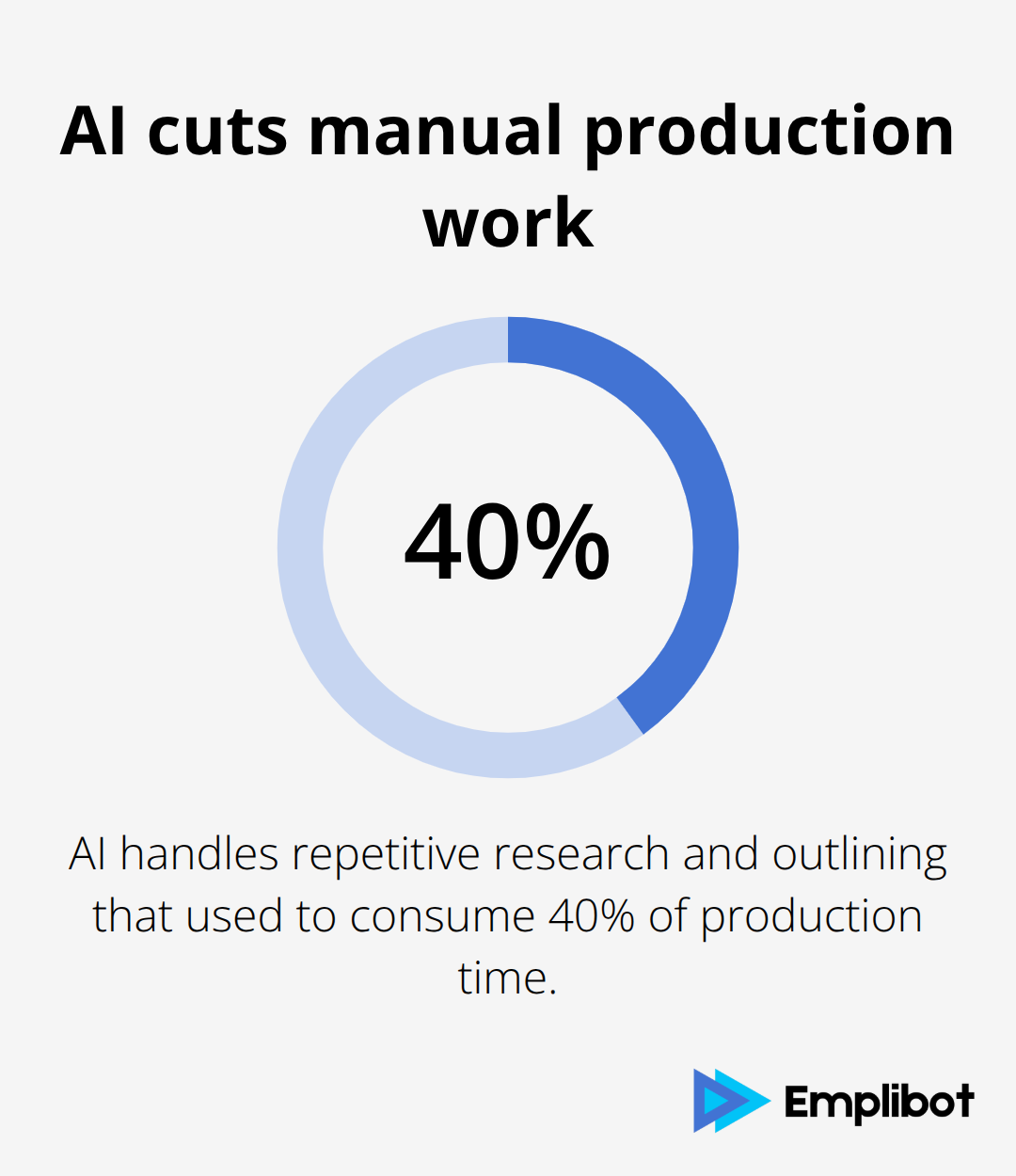
ContentShake AI combines language models with SEO data to generate blog posts in multiple languages with brand-voice customization, while Surfer SEO provides real-time optimization scoring and keyword insights that guide content briefs before writers even start. The 2024 State of Marketing AI Report found that many marketers now say they couldn’t live without AI for content tasks-and the reason is simple: AI handles the repetitive research and outlining work that used to consume 40% of production time.
Research and Insights at Machine Speed
Research and data analysis happen in minutes instead of days when AI processes unstructured information from reviews, social media, and competitor websites to reveal customer preferences and market trends. Brand24 monitors news, social platforms, blogs, and forums with sentiment analysis, helping teams understand how audiences perceive their brand across channels-a capability used by Uber, Stanford University, and Intel to stay ahead of perception shifts. AI-powered analytics accelerate trend forecasting and convert raw insights into actionable marketing decisions, meaning your team spends less time in spreadsheets and more time on strategy.
Distribution Across Channels
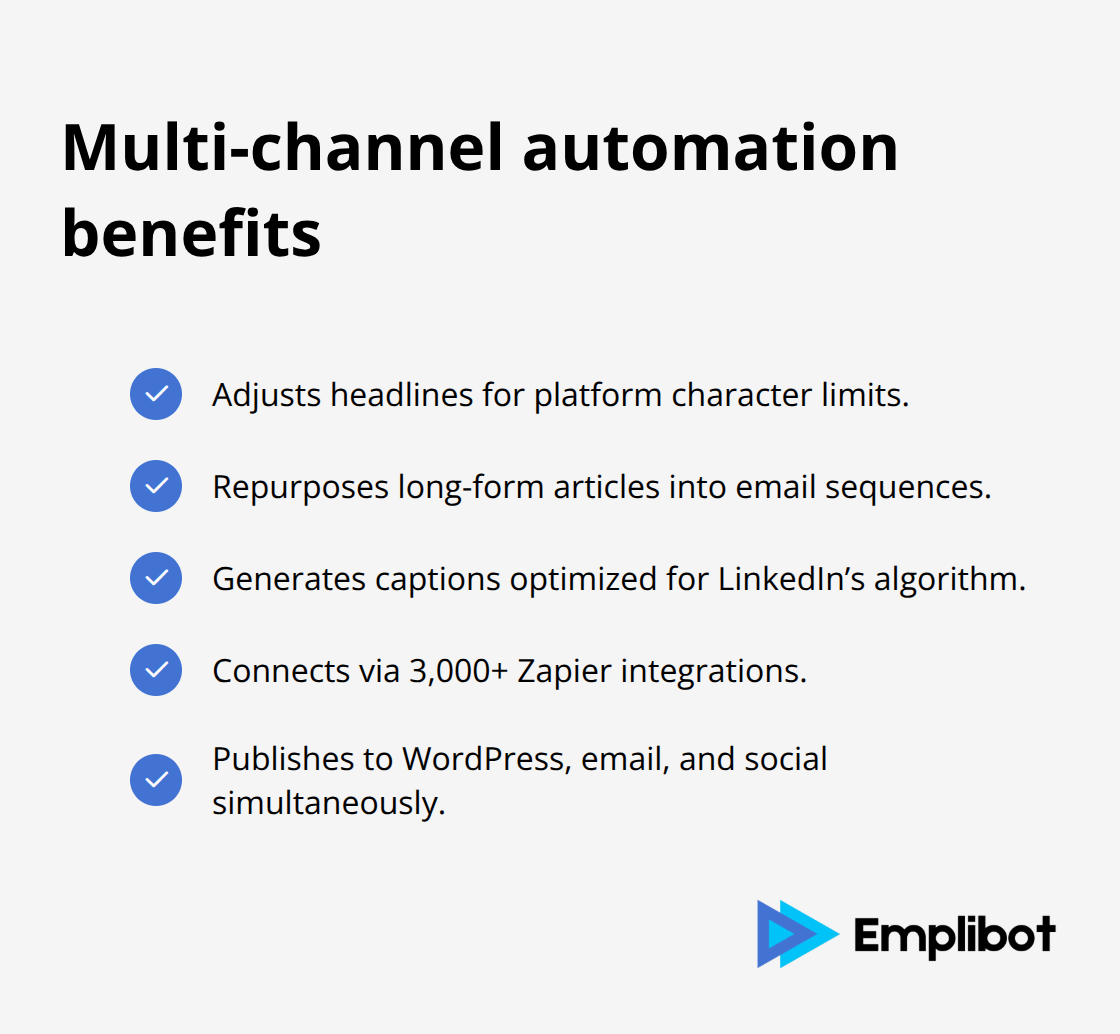
The speed advantage compounds when you combine content creation with distribution: AI publishes optimized articles across WordPress, social platforms, and email simultaneously, adjusting headlines, tone, and format for each channel. This scalability matters because personalization at scale powered by AI improves engagement and conversions by tailoring messages to individual user signals. However, speed and scale create a serious risk-the quality control and fact-checking burden shifts entirely to your team, which brings us to the real obstacles that emerge when you scale AI-driven content production.
AI Tools That Optimize Content and Amplify Reach
Real-Time SEO Optimization During the Writing Process
SEO optimization happens in real time when AI analyzes search intent, competitor rankings, and keyword difficulty before your writers start drafting. Surfer SEO integrates directly into WordPress and Google Docs to score content against top-ranking pages, flagging keyword density, word count, and semantic relevance as you write-clients like FedEx, Shopify, Qantas, and Viacom use it to cut the gap between draft and publish-ready by days. ContentShake AI pulls keyword data from Semrush alongside language models to generate entire briefs with recommended word counts, heading structures, and image placement, meaning your team receives an SEO-first outline instead of writing blind and optimizing later. McKinsey research shows AI-driven audience insights optimize channel mix and budget allocation, potentially increasing marketing ROI. When you skip the manual keyword research phase and let AI handle competitive analysis, your writers focus on quality and messaging instead of spreadsheet work.
Measuring Performance to Guide Future Content
Content performance analytics reveal which topics, formats, and messaging drive conversions-not just traffic. AI processes engagement signals across your blog, email, and social channels to show which articles generate leads, how long readers stay on each page, and which headlines get clicked most. Gartner research indicates AI-enabled attribution and measurement refine understanding of content ROI across channels, which means you stop guessing about what works and start adjusting in real time. Tools like FullStory map visitor journeys across thousands of interactions to show exactly where audiences drop off or convert, helping teams understand UX friction that kills engagement. Clients including GAP, Zipcar, Icelandair, and Forbes use this data to test and iterate messaging rather than publish once and move on. Deloitte and Gartner research confirms that predictive content performance forecasting helps editorial teams plan ahead, reducing waste and unused inventory. When AI shows that how-to content outperforms opinion pieces by 3x in your niche, your next quarter’s editorial calendar shifts accordingly.
Automating Distribution Across Multiple Channels
Multi-platform distribution demands different formats, headlines, and tone for each channel-a task that becomes tedious at scale without automation. AI adjusts blog headlines for Twitter character limits, transforms long-form articles into email sequences, and generates captions optimized for LinkedIn’s algorithm, all from a single source document. Zapier enables no-code automations across 3,000+ integrations, letting you connect your content creation tools to WordPress, email platforms, and social schedulers so new articles publish everywhere simultaneously.
The real value emerges when AI combines distribution with personalization: by analyzing data such as browsing history, demographics, and engagement patterns, AI can create dynamic content that resonates with specific audiences. Forrester research confirms that AI-driven personalization across email, web, and product pages should be tested and iterated with controlled experiments. This multi-channel approach removes friction from your publishing workflow, but it also introduces a new problem-maintaining consistency and quality across all those variations becomes harder when you’re publishing at scale, which is exactly where the next set of challenges emerges.
Where AI Content Breaks Down
Speed and scale sound great until your brand voice becomes unrecognizable or your audience spots factual errors that damage credibility. The tools we mentioned earlier-ContentShake AI, Surfer SEO, and others-excel at producing volume and optimizing for search algorithms, but they lack understanding of what makes your brand distinct or whether the claims in your content are actually true. Google’s Helpful Content Update addresses content that lacks demonstrated expertise and original insight, meaning AI-generated pieces that read like templates get buried in search results.
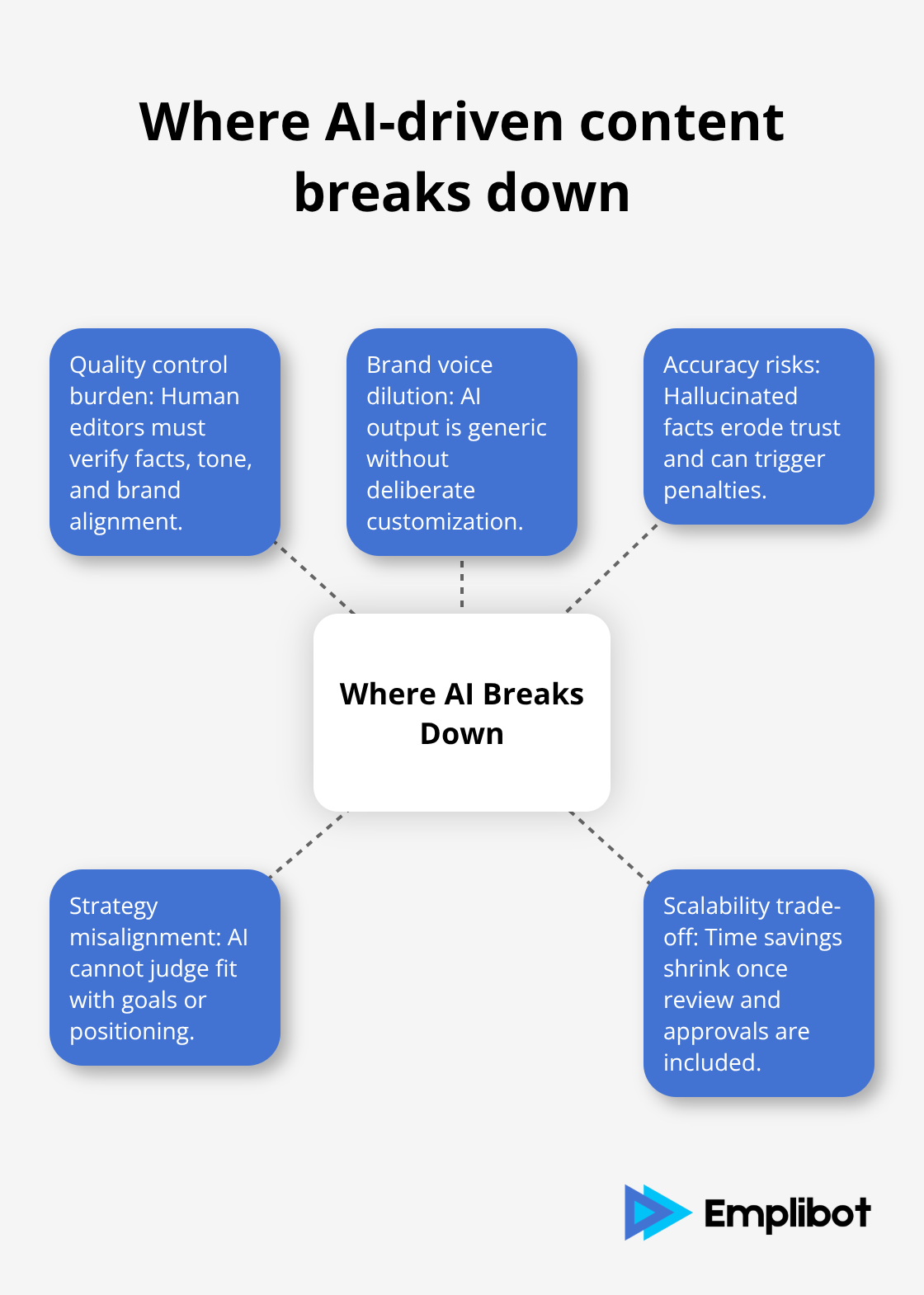
Your team still needs to edit every piece for tone, accuracy, and brand alignment, which means the time savings from automation shrink significantly when you factor in quality review.
ContentShake AI and similar tools can generate a draft in minutes, but a human editor needs 30-60 minutes to verify facts, adjust phrasing, and ensure the piece reflects your actual expertise. That’s not a flaw in the tools-it’s the reality of responsible content marketing. The cost-per-article doesn’t drop as dramatically as vendors claim because human oversight becomes non-negotiable.
AI Language Models Hallucinate Facts
AI hallucinations occur when language models perceive patterns or objects that are nonexistent, creating nonsensical or inaccurate outputs. A model might cite a study that doesn’t exist, attribute quotes to the wrong person, or state statistics backwards. When you publish without verification, your audience loses trust and search engines penalize you for misinformation. Google’s own guidance on AI-generated content states that human review for accuracy is mandatory, not optional.
Every piece requires someone to verify facts against original sources, check that statistics come from real research, and confirm that product features are described correctly. For content teams publishing five pieces per week, that’s a substantial workload that AI doesn’t reduce. The vendors selling you AI tools won’t emphasize this, but it’s the single biggest constraint on how much you can actually automate. If you publish content entirely to AI without dedicated fact-checking, you build a liability.
Your Strategy Requires Human Judgment
AI can identify trending topics and suggest content angles based on search volume, but it cannot decide whether those topics align with your business goals or your audience’s actual needs. An AI tool might recommend writing about a hot topic that gets 10,000 monthly searches but attracts an audience completely wrong for your product. Your strategist needs to evaluate whether the topic converts, whether your team can establish authority in that space, and whether it fits your long-term positioning.
AI also cannot navigate competitive positioning or decide which content pillars matter most for your market. Tools like Surfer SEO show you what competitors rank for, but they don’t tell you whether you should compete in those spaces or own adjacent niches where you face less resistance. Your editorial strategy-the decision about what to build authority in and how to differentiate-remains fundamentally human work.
Brand Voice Demands Human Refinement
AI produces generic output that sounds like every other AI-generated piece on the internet. Your brand voice-the specific tone, vocabulary, and perspective that makes your content recognizable-cannot emerge from a language model trained on millions of generic sources. A financial services firm needs to sound authoritative and precise. A SaaS startup needs to sound approachable and conversational. A luxury brand needs to sound exclusive and refined. AI tools don’t understand these distinctions without extensive training data specific to your brand.
Your editors must customize AI content to inject personality and authenticity, a process that consumes 30-60 minutes per piece. This editing work doesn’t scale, which means the promised productivity gains flatten quickly when you account for the human refinement that separates mediocre content from content that actually builds brand recognition and trust.
Human expertise accelerates execution once strategy is clear, but it cannot be replaced by the thinking that precedes execution.
Final Thoughts
The future of content marketing isn’t about choosing between AI and human expertise-it’s about building workflows where both work together. Teams that win in 2026 will treat AI as a research and production accelerator while keeping humans in charge of strategy, quality, and brand voice. Companies using tools like Emplibot to automate WordPress publishing and social distribution while maintaining editorial control demonstrate how AI impacts content marketing when you structure the process correctly.
How you implement AI determines whether it strengthens or weakens your content strategy. If you use AI to handle keyword research, outline creation, and first-draft writing, your team gains 15-20 hours per week to focus on strategy, fact-checking, and brand refinement. If you treat AI as a replacement for human judgment, you’ll publish generic content that damages credibility and wastes your distribution channels.
Start by auditing your current workflow to identify which tasks consume the most time without requiring strategic judgment. Keyword research, outline creation, first drafts, and performance reporting are prime candidates for AI automation, but invest equally in quality control around fact-checking and brand voice refinement. Your competitive advantage won’t come from using AI faster than competitors; it will come from using AI smarter by combining machine efficiency with human judgment that competitors skip.