

Snapchat’s Perplexity integration marks a major shift in how users search for information within social platforms. Starting January 2026, Perplexity will become the default assistant, transforming chat conversations into answer engine surfaces.
This change creates new opportunities for content creators to capture traffic from social search behaviors. We at Emplibot see this as a game-changing moment for content distribution strategies.
What Changes When Snapchat Makes Perplexity the Default Assistant
The $400 Million Deal Reshapes Social Search
Snap invested $400 million in Perplexity to position the AI answer engine as the primary assistant for 477 million daily active users starting January 2026. This deal replaces traditional search behaviors within the app, where users previously relied on external browsers or basic chatbot responses. Perplexity currently processes over 150 million questions weekly across all platforms, but the Snapchat integration will expose it to a concentrated audience of users aged 13-34 across 25 countries.

The financial commitment signals Snap’s intention to make this the primary way users access information, not just an optional feature.
Social Chat Becomes Answer Engine Territory
Users who ask questions in Snapchat’s chat interface will receive research-backed responses with verified sources instead of casual chatbot replies. This creates a new search surface that competes directly with Google and traditional search engines, but within a social context where users share answers immediately. Perplexity’s strength in research accuracy (compared to other chatbots) means users will get fact-checked responses that they trust enough to share with friends.
Traffic Patterns Shift Away From Traditional Web Search
The integration positions every Snapchat conversation as a potential search session, which fundamentally changes how information spreads through social networks. Content creators who optimize for these conversational queries will capture traffic that never leaves the social platform. This represents a significant shift from traditional web-based search traffic patterns, where users would exit social apps to find answers on external websites.
The next step involves understanding how to create content that performs well in this new social answer engine environment.
How Do You Format Content for Social Answer Engines
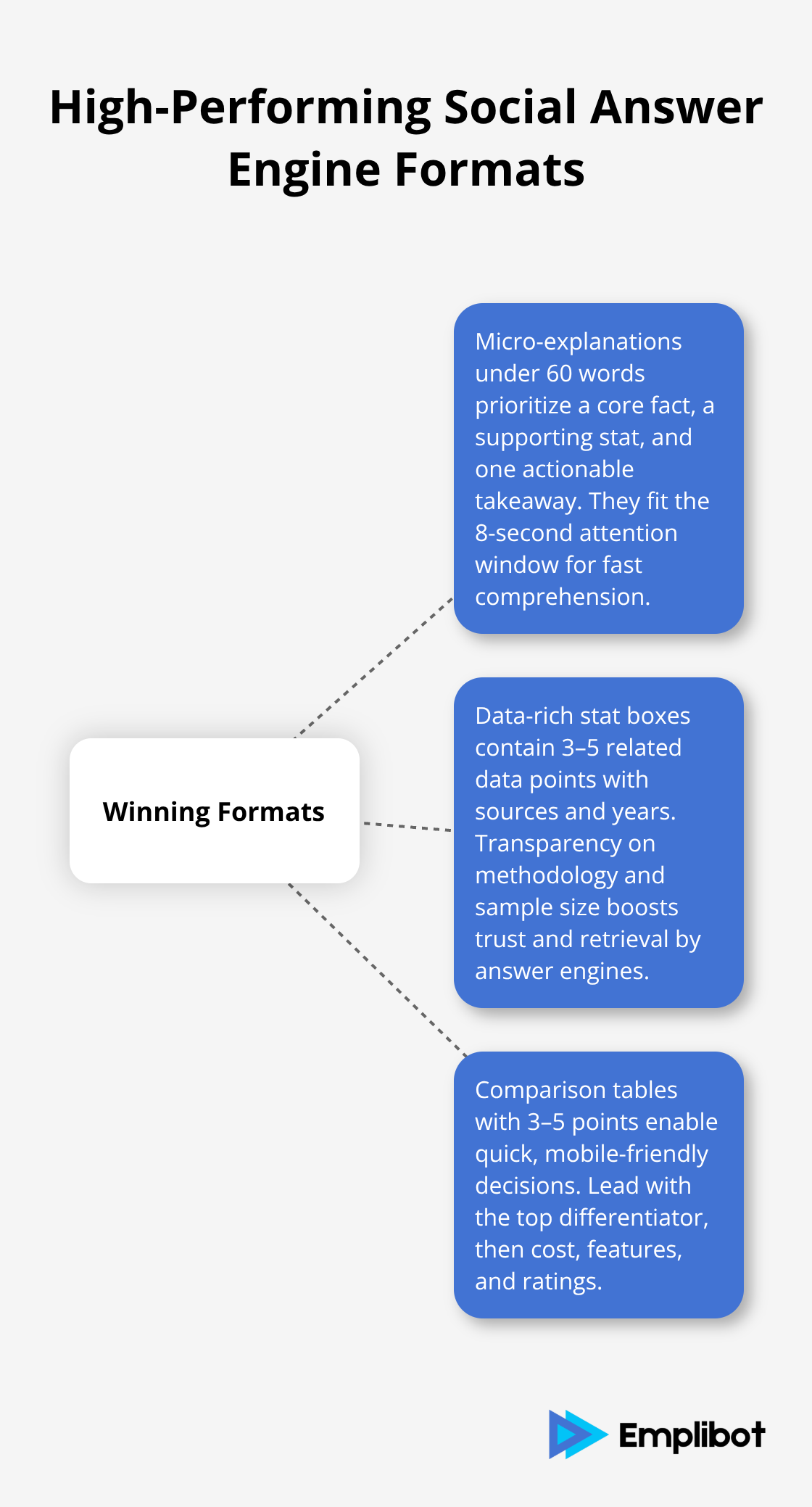
Social answer engines like Perplexity prioritize content that delivers immediate value through scannable formats. Your content needs to match the conversational nature of social searches while providing authoritative information that users trust enough to share. Focus on three specific content structures that perform exceptionally well in this environment.
Create Micro-Explanations That Fit Social Sharing
Write explanations that clock in under 60 words for complex topics. Research shows human attention spans dropped to 8 seconds by 2015, making quick comprehension critical for social platforms. Your explanations must answer the core question within this attention window. Structure each answer with one key fact, one supporting statistic, and one actionable insight. Instead of writing lengthy paragraphs about email marketing metrics, create tight explanations like: Email campaigns with personalized subject lines generate 26% higher open rates according to Campaign Monitor data from 2024. Test three subject line variations per campaign to identify what resonates with your specific audience segments. This approach works because social users want quick answers they can immediately apply or discuss with others.
Build Authority Through Data-Rich Content Blocks
Create standalone stat boxes that position your content as the definitive source for specific information. Each stat box should contain three to five related data points with clear attribution to named sources and publication years. Research indicates that content featuring original research and curated statistics receives significantly more social shares than opinion-based content. Structure these boxes with the headline statistic first, followed by supporting data points that add context. Include the methodology or sample size when available (as Perplexity specifically rewards content that provides research transparency). A stat box about social commerce might feature: 76% of consumers purchase products seen on social media according to Sprout Social 2024 research. Instagram drives 32% of social commerce traffic per Shopify data. Gen Z consumers spend 2.5 hours daily on social platforms per Pew Research findings. This format gives answer engines multiple data points to pull from while establishing your content as authoritative.
Design Comparison Tables for Quick Decision Making
Build comparison tables that help users make decisions without leaving the social platform. Tables with three to five comparison points perform best because they fit mobile screen real estate while providing enough detail for informed choices. Nielsen Norman Group research shows users scan comparison content in an F-pattern (focusing on the first two rows and left column most heavily). Structure your tables with the most important differentiator in the first row, followed by cost, features, and user ratings. Keep cell content to 10 words maximum to maintain readability on mobile devices. Answer engines favor tabular data because it provides structured information that can be easily parsed and presented to users. Create tables that directly address common comparison queries in your industry, such as pricing differences, feature availability, or performance metrics across competing solutions.
These content formats work best when paired with strategic distribution tactics that maximize their reach across social platforms.
How Do You Optimize Content for Social Platform Sharing
Master Open Graph Tags for Maximum Social Impact
Open Graph titles must stay under 60 characters while including your primary keyword and value proposition. Facebook truncates titles at 60 characters, Twitter at 70, but consistency across platforms requires the shorter limit. Write titles that work as standalone headlines, not dependent on context. Research from BuzzSumo shows content with numbers in titles receives more social shares than those without.
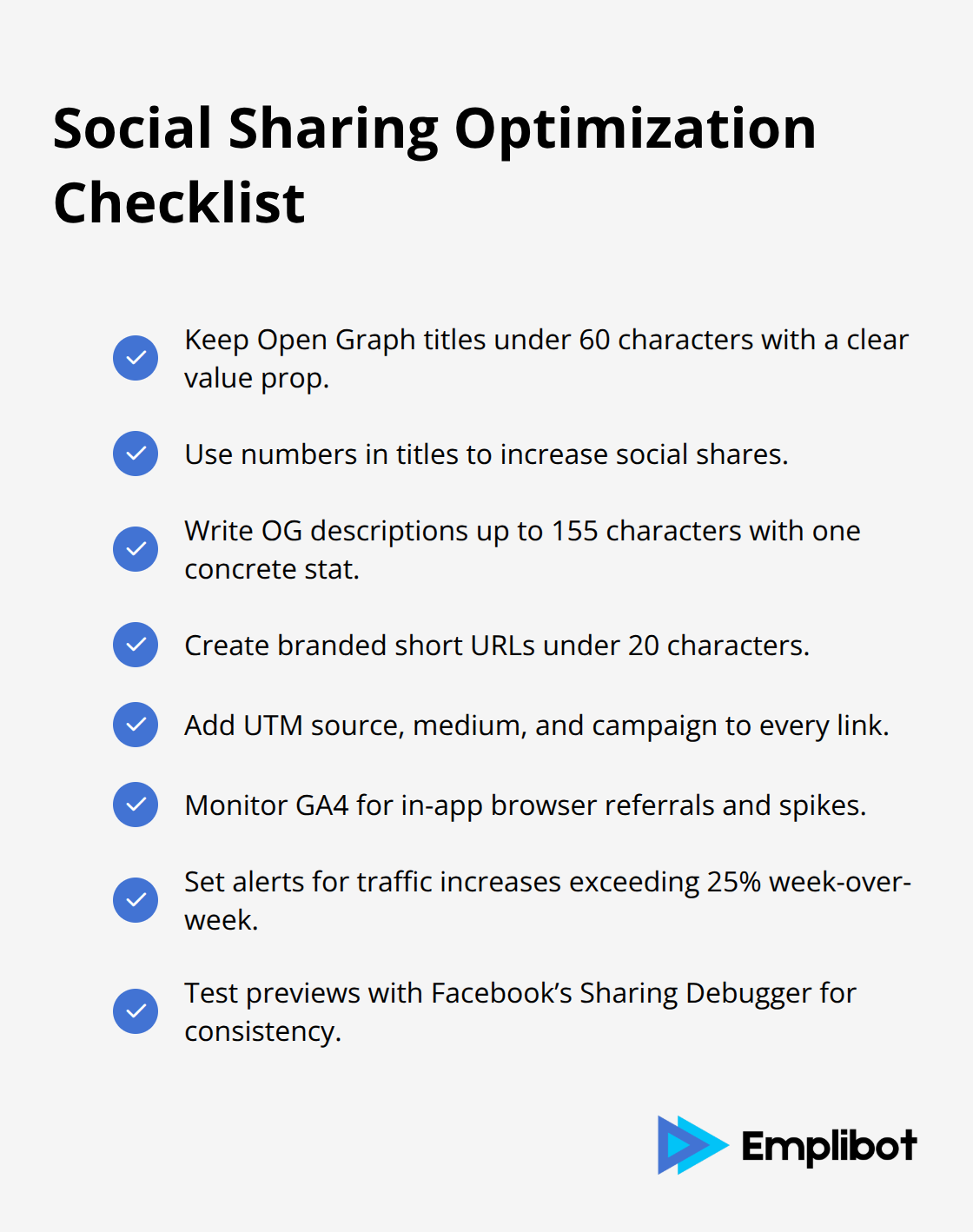
Your Open Graph description should clock in at 155 characters maximum to avoid truncation across all major platforms. Focus descriptions on the specific benefit users gain from your content rather than generic language. Include one concrete statistic or data point in every description to establish immediate credibility. Test different description formats with tools like Facebook’s Sharing Debugger to see how your content appears in feeds. Social platforms prioritize content that generates engagement, so descriptions that promise actionable insights or surprising facts typically outperform vague statements.
Implement Short URLs and UTM Tracking for Performance Analysis
Branded links increase click-through rates by up to 39% because people trust recognizable brand names more than random character strings, particularly important for mobile users who represent 98.8% of Snapchat’s audience. Create branded short URLs with services like Bitly or TinyURL rather than platform-generated links, which often appear spammy in social feeds. Your short URL should hint at the content topic while staying under 20 characters total. UTM parameters become essential for measuring social traffic performance, especially as traditional analytics struggle to track social platform referrals accurately. Tag every social link with campaign source, medium, and campaign name parameters. Use consistent conventions like utm_source=snapchat, utm_medium=social, utm_campaign=perplexity-integration to maintain clean data tracking. Monitor referral spikes from in-app browsers with Google Analytics 4 enhanced measurement, which captures social platform traffic that standard tracking often misses. Set up automated alerts for traffic increases exceeding 25% week-over-week to identify viral content patterns quickly.
Scale Distribution Through Automation and Refresh Cycles
Content automation tools handle the repetitive aspects of social distribution while maintaining quality standards. Schedule content refreshes every 90 days to capture new social search queries as user behavior evolves on platforms like Snapchat. Automation works best for posting cadence, UTM tag generation, and social media cross-posting, but requires human oversight for platform-specific optimization. Set up automated workflows that republish top-performing content with updated statistics and sources, keeping your information current for answer engines that prioritize fresh data. Monitor social platform algorithm changes monthly, as platforms like Snapchat frequently adjust how they surface and rank answer content.
Final Thoughts
Snapchat’s Perplexity integration creates immediate opportunities for content creators who adapt their strategies quickly. Track referral traffic spikes from in-app browsers with Google Analytics 4 enhanced measurement to identify which content formats generate the most engagement within social chat environments. Set up automated alerts for traffic increases that exceed 25% week-over-week to spot viral content patterns early.
Content automation becomes essential for consistent presence across social answer engines. Emplibot automates your WordPress blog and social media with keyword research, content creation, and SEO optimization that produces high-quality content tailored to your business while it distributes across platforms like LinkedIn, Facebook, and Twitter. Schedule content refreshes every 90 days to capture evolving user search behaviors as more platforms integrate AI answer engines.
The social answer engine landscape will expand rapidly beyond Snapchat’s Perplexity integration. Instagram, TikTok, and other platforms are likely to follow with similar integrations that create multiple surfaces where your optimized content can capture search traffic. Position your content strategy now to scale across these emerging channels as they develop their own AI-powered search capabilities (which industry analysts predict will happen within the next 18 months).