

Google’s December 2025 core update has already shifted rankings across multiple industries. Sites are seeing significant volatility, and the algorithm changes are hitting harder than many expected.
At Emplibot, we’ve analyzed the patterns and compiled what you need to know to protect your rankings and recover if you’ve been affected. This guide walks you through the timeline, Google’s priorities, and the exact steps to monitor and improve your performance.
When the December 2025 Update Rolled Out and What It Actually Hit
Google announced the December 2025 core update on December 11, 2025, with a rollout period expected to last up to three weeks. This marks the third core update of 2025, following March and June updates. The rollout began immediately, with early SERP changes accelerating starting December 14–15 and continuing through the period. According to SEMrush data, this update brought extreme volatility with a sensor reading of 8.7 out of 10, affecting an estimated 40 to 60 percent of sites globally. The update is global and multilingual, impacting all regions and languages equally.
Industries Hit Hardest and the Numbers Behind Them
E-commerce sites faced the heaviest impact, with approximately 52 percent experiencing significant ranking shifts. Health and YMYL topics suffered even more severely at 67 percent affected, reflecting Google’s intensified focus on expertise and authority in sensitive areas. Affiliate sites took the most severe blow, with 71 percent experiencing ranking changes.
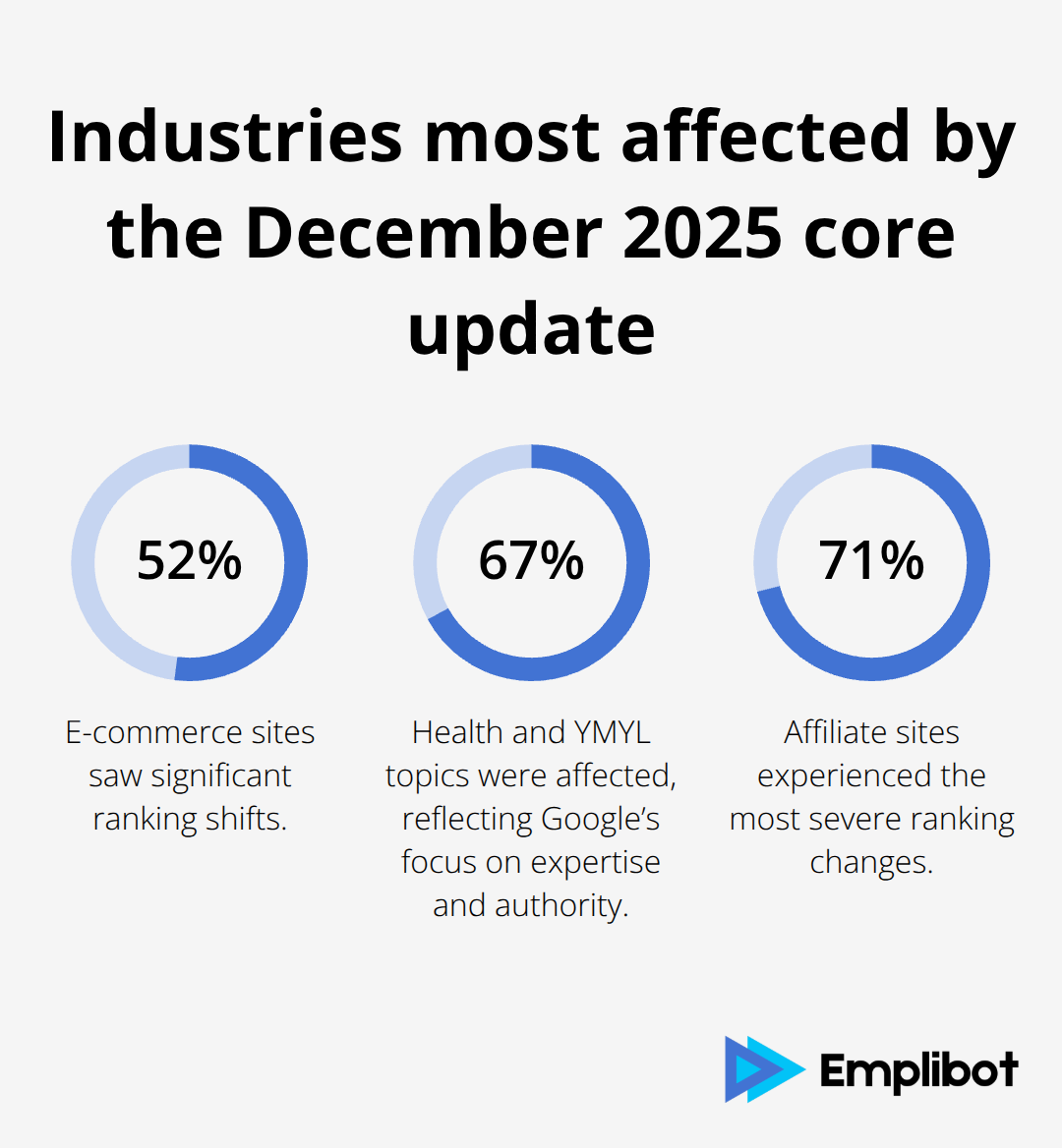
These numbers come from SEMrush’s tracking of the update window and reveal that Google’s algorithm changes were far from uniform. In the UK alone, the top 100 domains showed both massive winners and losers across reference, informational, and ecommerce verticals. Oxford Learners Dictionaries gained 8.93 percent visibility, while Trustpilot surged 17.8 percent. Meanwhile, Britannica lost 1.92 percent and Collins Dictionary dropped 8.72 percent. Some domains experienced extreme volatility, with Louisiana.gov jumping 310.97 percent, Royal Free NHS jumping 305.87 percent, and Mands Travel Money gaining 251.12 percent. The opposite happened for others: Napier.ac.uk fell 43.88 percent, Ducksters dropped 43.30 percent, and Song Meanings lost 41.78 percent. These swings indicate that the update rewarded specific content characteristics while penalizing others across all topic areas.
What the Ranking Patterns Actually Reveal
The real story isn’t random volatility-it’s systematic. Sites with mass-produced AI content without expert oversight suffered disproportionately. User satisfaction signals became more influential, with high pogostick rates above 40 percent actively hurting rankings, while long-click rates above 60 percent and strong dwell time boosted performance. Google’s evaluation now heavily weights E-E-A-T signals across virtually all topics, not just health and finance. Content freshness shifted from simple date updates to substantial, meaningful improvements with updated data and new insights. Core Web Vitals thresholds tightened significantly: LCP must be under 2.5 seconds, INP ideally under 200 milliseconds, and CLS under 0.1. Mobile experience became non-negotiable. Recovery timelines vary by industry: non-YMYL sites typically recover in 4 to 6 months, while YMYL topics may take 12 to 18 months.
How These Patterns Shape Your Recovery Path
The mechanisms Google deployed reward sites that combine human expertise with strategic content improvements. Sites that invested in original data, updated insights, and clear author credentials recovered faster than those that relied on outdated or thin content. Technical performance matters just as much-sites that optimized Core Web Vitals alongside content improvements saw better results. The update penalized mass-produced AI content, but AI tools combined with expert oversight actually helped some sites recover. This distinction matters: AI-only publishing failed, while expert-led content enhanced by AI research and optimization succeeded. Understanding these patterns helps you prioritize which improvements will move the needle first.
What Google Actually Prioritizes Now
The Core Shift: Authenticity Over Everything Else
Google’s official statement on the December 2025 core update emphasizes a straightforward principle: the algorithm now surfaces more relevant and satisfying content across all types of sites. This isn’t a penalty-driven update targeting specific violations. Instead, Google refined its core ranking signals to better identify pages that genuinely serve user intent. The company describes this as a regular adjustment, consistent with how it handles algorithm evolution, but the data tells a more specific story. Google Search Central confirmed that the update targets content authenticity, expertise, and user satisfaction as primary evaluation criteria.
The shift matters because it moves away from treating these signals as secondary factors. E-E-A-T now influences rankings across virtually every topic, not just health and finance where it previously dominated. Author credentials and demonstrated expertise have become table-stakes for competitive rankings. A finance article needs clear author credentials about investment background, just as a technical guide needs to show the writer’s hands-on experience. Mass-produced AI content without expert oversight gets systematically downranked because it fails this authenticity test.
Content Freshness Now Means Real Updates
Content freshness standards changed dramatically. Google no longer rewards simple date updates or republishing old content with new timestamps. The algorithm now identifies substantial, meaningful improvements-updated data points, new research findings, original insights, and refreshed methodology. A blog post from 2022 with a 2025 publication date but identical information drops in rankings. Meanwhile, a thorough update adding new case studies, current statistics, and revised recommendations climbs.
This distinction separates sites that genuinely improve their content from those that game the system. Sites that add original research, incorporate fresh data, and refresh their methodology signal to Google that they maintain high standards. Those that simply change dates without substantive changes face ranking penalties.
User Satisfaction Signals Now Drive Rankings
User satisfaction signals became significantly more influential in ranking calculations. Data from Chrome and Android populations shows that pogostick rates ranking impact above 40 percent actively hurt rankings, indicating users aren’t finding what they need. Long-click rates above 60 percent and strong dwell time boost performance because they signal genuine value. These metrics (derived from real user behavior across Google’s ecosystem) now carry more weight than they did in previous updates.
Sites that fail to satisfy searchers lose ground regardless of other factors. A page with excellent technical performance but poor user engagement drops in rankings. Conversely, pages that keep users engaged and satisfied climb, even if they face minor technical limitations.
Technical Performance Thresholds Tightened Significantly
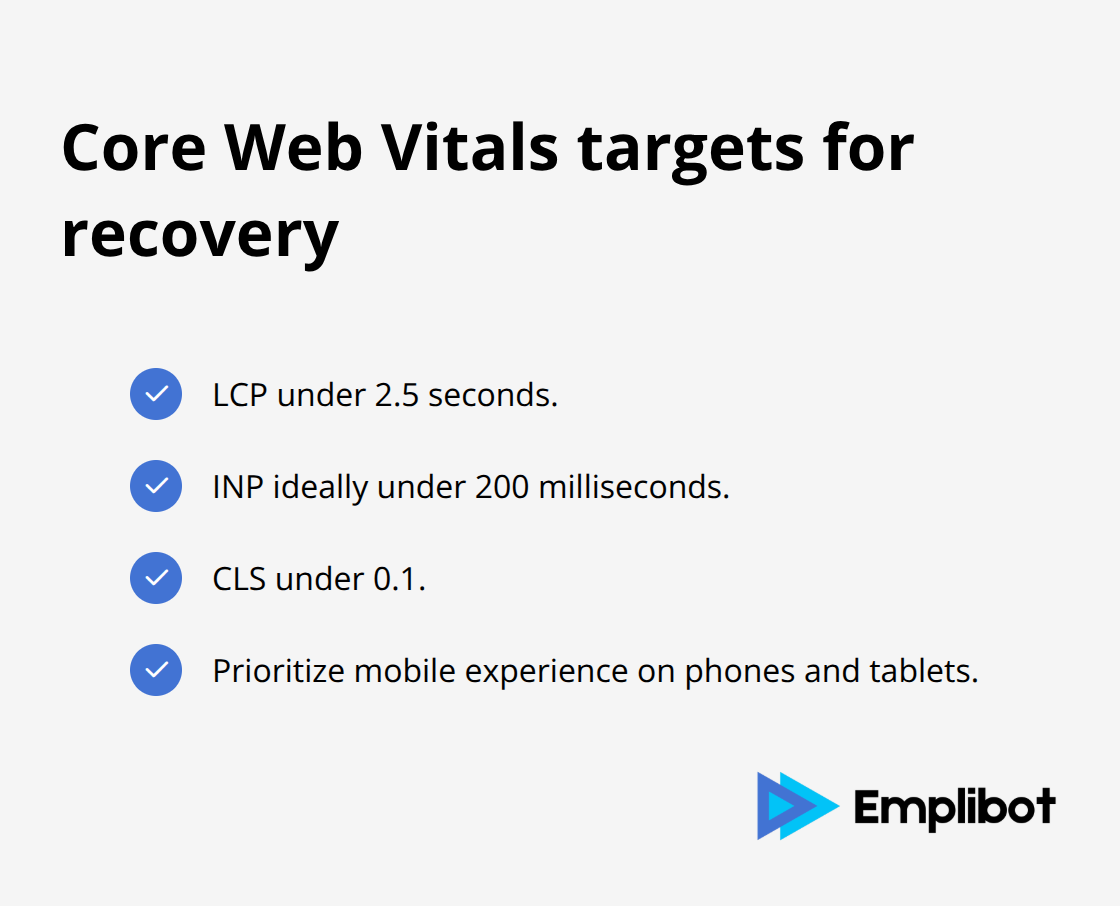
Core Web Vitals thresholds tightened considerably: LCP must stay under 2.5 seconds, INP ideally under 200 milliseconds, and CLS under 0.1. This differs from previous core updates where performance was important but more forgiving. Now, a site with mediocre technical speed loses ground even if content quality is solid. Mobile experience became non-negotiable because Google’s evaluation prioritizes how pages perform on phones and tablets where most searches happen.
Sites that invested in performance optimization-WebP image formats, fast server response times, optimized JavaScript-recovered faster than those that ignored technical factors. The update penalized slow sites across all industries, making speed a competitive necessity rather than a nice-to-have feature.
What This Means for Your Next Steps
These priorities reshape how you should approach recovery and ongoing optimization. Content quality, user satisfaction, and technical performance now work together as a unified ranking system rather than separate factors. Sites that address only one area while neglecting others will continue to struggle. The sites that recovered fastest combined expert-authored content with meaningful updates, strong user engagement signals, and solid technical performance. Understanding which of your pages fail these criteria helps you prioritize your recovery roadmap and allocate resources where they’ll have the most impact.
How to Monitor Your Recovery and Diagnose What Went Wrong
Measure Impact With the Right Tools
Start measuring impact immediately with Google Search Console and Google Analytics 4. In GSC, navigate to the Performance report and set a date range from December 11, 2025, forward, comparing it against the same period from 2024. Look for drops in impressions, clicks, and average position across your top-performing keywords. Analytics 4 reveals user behavior shifts: check your traffic by landing page, bounce rate, and engagement metrics to identify which content lost traction.
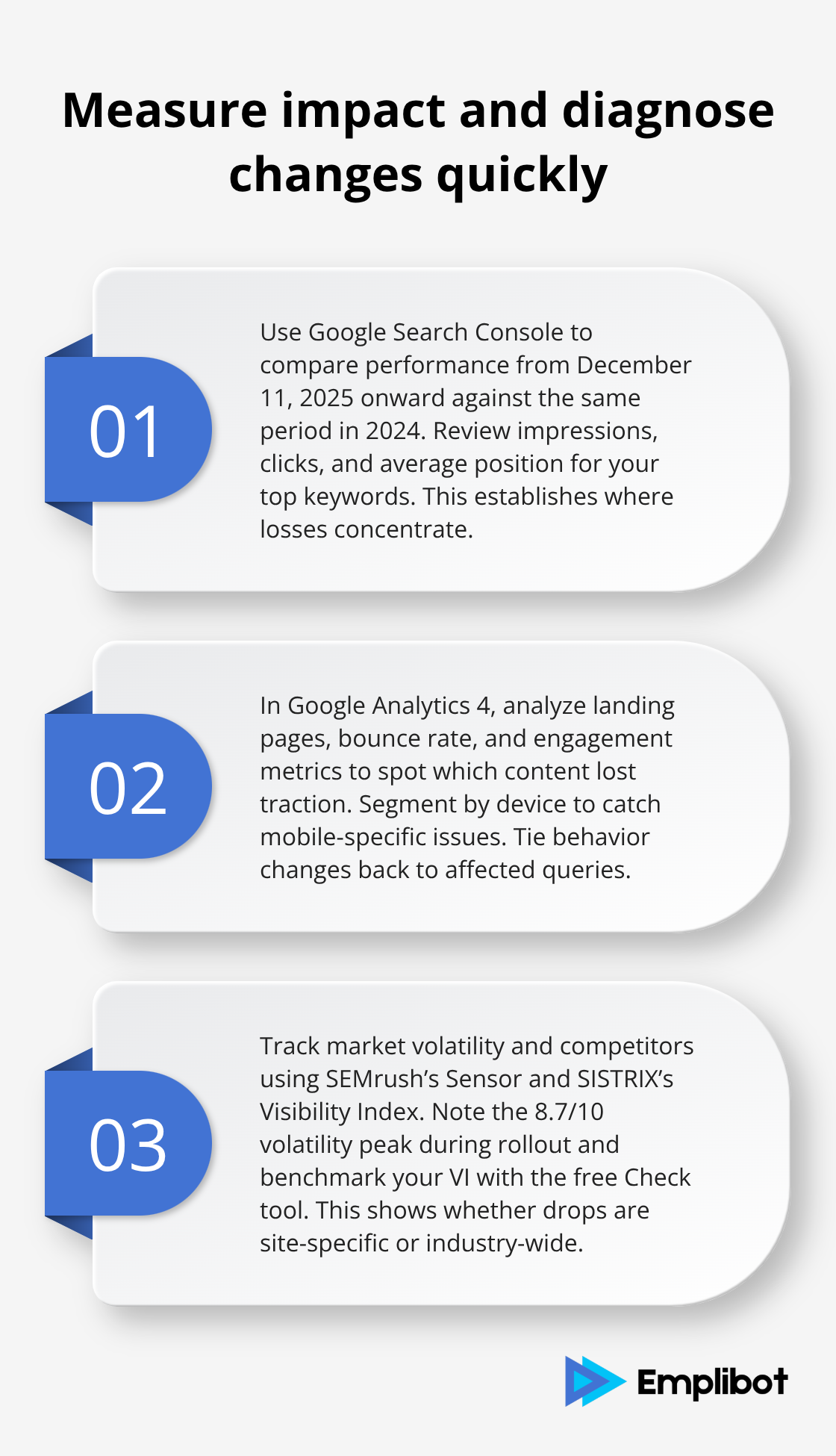
SEMrush’s sensor shows volatility peaked at 8.7 out of 10 during the rollout, meaning ranking fluctuations were extreme across industries. SISTRIX’s Visibility Index tracks domain-level performance changes more accurately than individual keyword rankings because it aggregates thousands of SERP positions into a single metric. Use their free VI Check Tool to see your live Visibility Index and compare it against competitors in your space.
Access Deeper Analysis With Free Trials
If you want deeper analysis, SISTRIX offers a 14-day free trial that unlocks the full Toolbox, including historical visibility data and update impact timelines. Google Update Radar from SISTRIX provides daily SERP movement across roughly 1 million searches, helping you understand whether volatility continues or stabilizes in your industry. These tools work together: GSC and GA4 show what happened to your traffic, while SISTRIX and SEMrush reveal ranking shifts and competitive positioning.
Run a Technical Audit on Your Top Declining Pages
Diagnose problems by running a technical audit focused on Core Web Vitals optimization, content quality, and user engagement patterns. Check your LCP, INP, and CLS scores in Google PageSpeed Insights, prioritizing pages that dropped the most in rankings. Pages with LCP above 2.5 seconds or INP above 200 milliseconds need optimization immediately because these metrics now heavily influence rankings.
Review your top 50 declining pages for mass-produced AI content, outdated information, and thin value propositions. If pages lack clear author credentials, update them with author bios that establish expertise and experience. Update publication dates only if you’ve made substantial content improvements: added new statistics, incorporated recent case studies, refreshed methodology, or included original research.
Evaluate Content Quality and User Engagement
Thin content under 600 words that doesn’t address searcher intent comprehensively should be consolidated with stronger pages or significantly expanded. Check your user engagement signals by analyzing pogostick rates in GA4: if more than 40 percent of users immediately bounce back to search results, your content isn’t matching search intent. Long-click rates above 60 percent indicate strong satisfaction, so identify these pages and use them as templates for improving underperforming content.
Mobile usability matters more now, so test pages on actual mobile devices and fix any navigation, readability, or interaction issues. Recovery timelines vary significantly: non-YMYL sites typically recover in 4 to 6 months with consistent improvements, while health and finance topics may take 12 to 18 months (because Google scrutinizes expertise more heavily in these areas).
Final Thoughts
The December 2025 Google core update fundamentally reshaped how search rankings work. Sites that combined expert-authored content with meaningful updates, strong user engagement, and solid technical performance recovered fastest. Those that relied on mass-produced AI content, outdated information, or poor mobile performance lost ground significantly.
Recovery takes time, not weeks. Non-YMYL sites typically regain lost visibility within 4 to 6 months of consistent improvements, while health and finance topics may take 12 to 18 months because Google scrutinizes expertise more heavily in these areas. This timeline matters for your planning because it means short-term panic doesn’t help-instead, focus on systematic improvements that address the core update’s priorities: update your content with fresh data and new insights, establish clear author credentials, optimize Core Web Vitals to meet tighter thresholds, and monitor user engagement signals to ensure your pages satisfy searchers.
Treat content quality and technical performance as non-negotiable moving forward. Use SISTRIX’s Visibility Index and Google Search Console to track your recovery weekly over the next 4 to 6 months, and monitor competitor movements in your industry to understand whether your improvements work relative to the landscape. If managing content updates, technical optimization, and SEO strategy feels overwhelming, Emplibot automates WordPress blog management and content distribution by handling keyword research, content creation, and SEO optimization automatically.