

Marketing teams waste thousands of hours on manual tasks that AI can handle in minutes. At Emplibot, we’ve seen firsthand how the right AI marketing tactics separate fast-growing companies from those stuck in outdated workflows.
This guide shows you exactly which AI strategies work, which mistakes to avoid, and how to implement them without breaking your existing systems.
How AI Transforms Your Marketing Operations
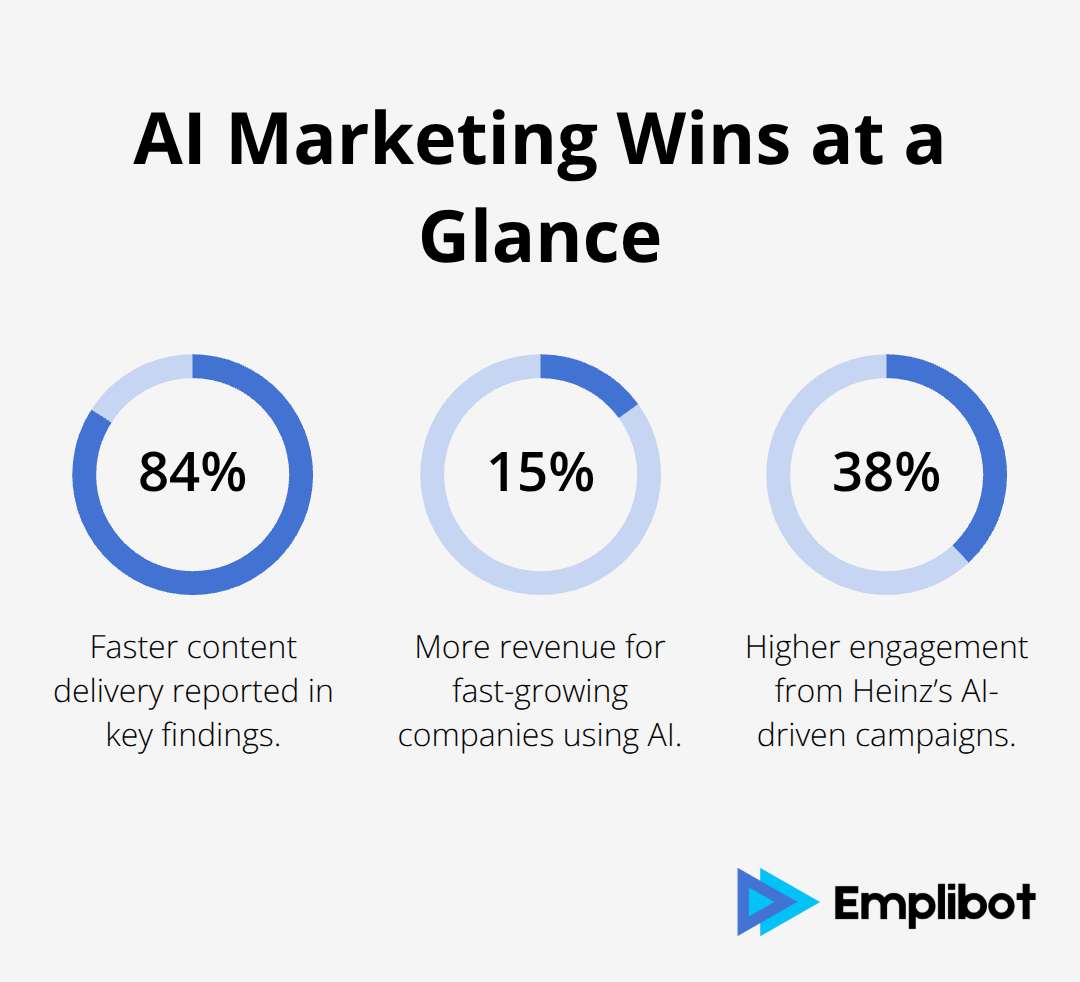
Marketing teams waste thousands of hours on manual tasks that AI handles in minutes. Key findings include 84% faster content delivery, significant cost reductions through personalization, and 15% more revenue for fast-growing companies. This isn’t marginal improvement-it’s the difference between a marketer handling one campaign and managing five simultaneously. Vector’s CEO content engine generates 4–5 posts per week with just a 15-minute human edit, proving that AI handles the heavy lifting while humans provide direction and voice.
When Oar Health needed to name a product, they used ChatGPT to generate hundreds of naming options in 2–3 hours instead of weeks of agency work. The winning name, Clutch, was chosen for its hard consonant sound and metaphorical resonance-something AI could suggest but humans had to evaluate and refine.
Speed Compounds When You Stop Manual Work
Adore Me deployed AI agents for product descriptions, translations, and stylist notes, cutting production time dramatically while boosting SEO signals across multiple languages. This matters because faster iteration means faster learning. You test more variations, spot what works sooner, and scale winners before competitors catch up. Fast-growing firms see about 40% more revenue from personalization, and that personalization only happens at scale when AI handles the data parsing and content customization. Verizon cut in-store customer service time by 7 minutes per customer using AI-assisted guidance for agents, which prevented approximately 100,000 churned customers. The time saved wasn’t wasted-it was redirected toward higher-value conversations. A.S. Watson deployed an AI-powered online skincare advisor that boosted conversions by 396% and increased average order value by 29% because the AI could surface the right product recommendations instantly, something manual processes never could.
Data Quality Determines Everything
Poor data makes AI worse than useless-it makes it dangerous. Your AI recommendations are only as good as the customer data feeding them. If your CRM is cluttered, your segmentation is sloppy, and your tracking is inconsistent, AI amplifies those problems at scale. This is why the best marketing teams start with data governance before touching AI. IBM partnered with Adobe Firefly to generate 200+ original images with 1,000+ variations, delivering 26x higher engagement. That success came from training the system on brand guidelines and historical performance data. Without clean input, AI generates quantity without quality. Start with an audit of what data you actually have, what’s missing, and where your systems don’t talk to each other. Then plug those gaps before you deploy AI at scale.
What Comes Next
The tactics that work depend on your foundation. Teams with solid data and clear processes see results immediately. Teams that skip the groundwork waste months fighting preventable problems. The next section shows you which specific AI tactics deliver measurable results and how to implement them without disrupting your existing workflow.
Which AI Tactics Actually Move the Needle
Content Creation at Scale Requires Training, Not Just Tools
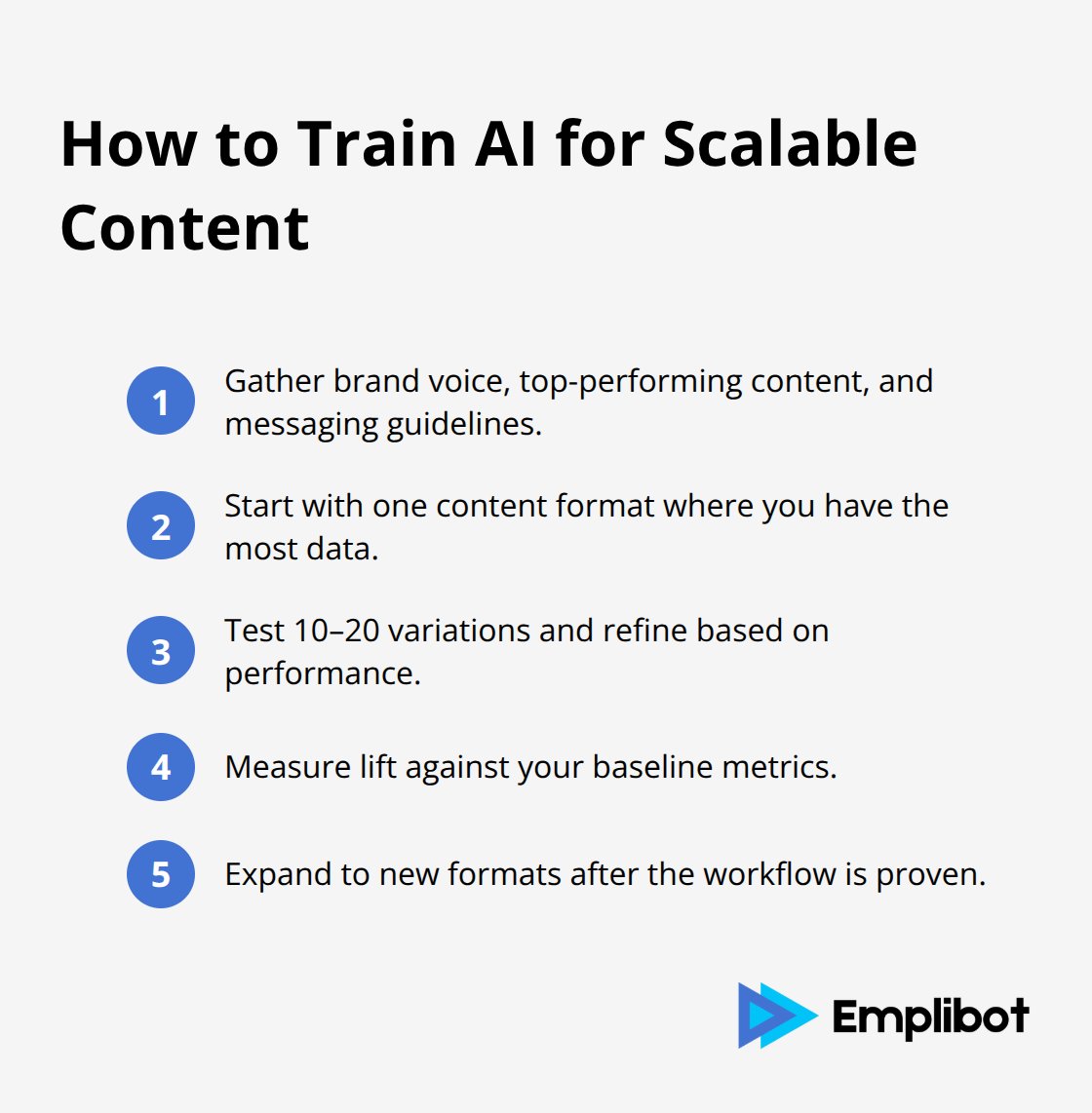
Content creation at scale separates winners from everyone else, and AI makes this possible without sacrificing quality. Virgin Holidays tested AI-generated subject lines and achieved a measurable open-rate lift by running 10–20 variations continuously and refining based on performance. That’s not theoretical-that’s what happens when you stop writing one subject line and start testing dozens. Vector’s CEO content engine produces 4–5 posts per week with a 15-minute human edit, which means a single marketer can maintain a consistent publishing cadence that would normally require a dedicated team. The key difference between success and failure is treating AI outputs as drafts, not finished work.
Train your AI on your actual brand voice, your best-performing content, and your messaging guidelines. Heinz deployed AI-driven campaigns that generated 850 million earned impressions and 38% higher engagement, delivering roughly 25 times the media value compared to traditional approaches. That didn’t happen because Heinz used a generic AI tool-it happened because they fed the system their brand assets, campaign objectives, and performance data. Start with one content format where you have the most data: email subject lines, product descriptions, or social captions. Measure the lift against your baseline. Then expand to formats where you have less historical data once you’ve proven the workflow.
Behavioral Signals Beat Demographics Every Time
Predictive systems fail when they’re built on guesses instead of behavior. Behavioral signals in customer segmentation turn generic campaigns into one-to-one experiences. That works because the AI isn’t just segmenting by demographics-it’s identifying which prospects are actually ready to buy based on their actions. Your CRM has this data already: which pages they visited, how long they spent there, which emails they opened, and what they downloaded. Most teams ignore it.
Build segments around real behavioral signals, not assumed preferences. A.S. Watson’s AI-powered online skincare advisor boosted conversions by 396% and increased average order value by 29% because the system could recommend the right product to the right person in the right moment, something rule-based automation never achieves.
Conversational AI Works Only When Connected to Real Customer Data
Conversational AI for lead generation qualifies prospects instantly instead of waiting for a sales rep to respond. The difference between a chatbot that wastes time and one that drives leads is whether it’s connected to your actual customer data and trained on your real sales conversations. If your team closes deals based on specific pain points, budget ranges, or industry fit, your chatbot needs to know that. Test chatbot performance against your baseline conversion rate from forms. If it’s not beating your existing process, the problem isn’t conversational AI-it’s that the system doesn’t have enough context about your customers. This gap between potential and performance determines whether you see results or frustration.
Where AI Goes Wrong in Marketing
Most teams deploy AI and immediately discover it creates more problems than it solves. The culprit is rarely the technology itself-it’s how they implement it. Automation without guardrails produces embarrassing outputs at scale. A chatbot trained on incomplete customer data qualifies the wrong leads. An email campaign generated by AI but never reviewed by a human reaches customers with tone-deaf messaging. These failures don’t happen because AI is broken; they happen because teams skip the foundation work. Verizon’s success with AI-assisted customer guidance came from pairing automation with trained agents who understood when to override the system. That human judgment prevented the AI from making terrible recommendations that would have damaged customer relationships.
Automation Needs Human Judgment, Not Just Monitoring
Your AI should handle repetitive mechanical work while humans handle judgment calls, brand voice, and strategic direction. When you flip that equation-letting AI make decisions while humans just monitor-conversions drop and complaints rise. The mistake most teams make is treating AI implementation as a technology project instead of a process redesign. You can’t plug in a new tool and expect results. You need to map where AI actually fits into your workflow, identify which decisions AI should make versus which ones humans must make, and build in checkpoints where someone reviews outputs before they reach customers.
Disconnected Systems Produce Disconnected Results
Integration failures destroy more AI implementations than poor strategy ever could. Your marketing stack probably includes a CRM, email platform, analytics tool, ad manager, and content calendar. Most of these systems don’t talk to each other. When you add AI on top of disconnected systems, you get disconnected results. An AI recommendation engine that can’t access your CRM data will make generic suggestions. An AI content tool that doesn’t know your publishing schedule or past performance will produce posts that clash with your strategy.
Adore Me succeeded because they integrated AI agents directly into their product workflow and connected the output to their CRM and analytics. That integration meant the AI could see what worked, learn from it, and improve. Without integration, you’re just adding another isolated tool to your growing pile of software. Before you buy any AI marketing tool, audit your existing systems. Which ones contain customer data? Which ones track performance? Which ones control your workflows?
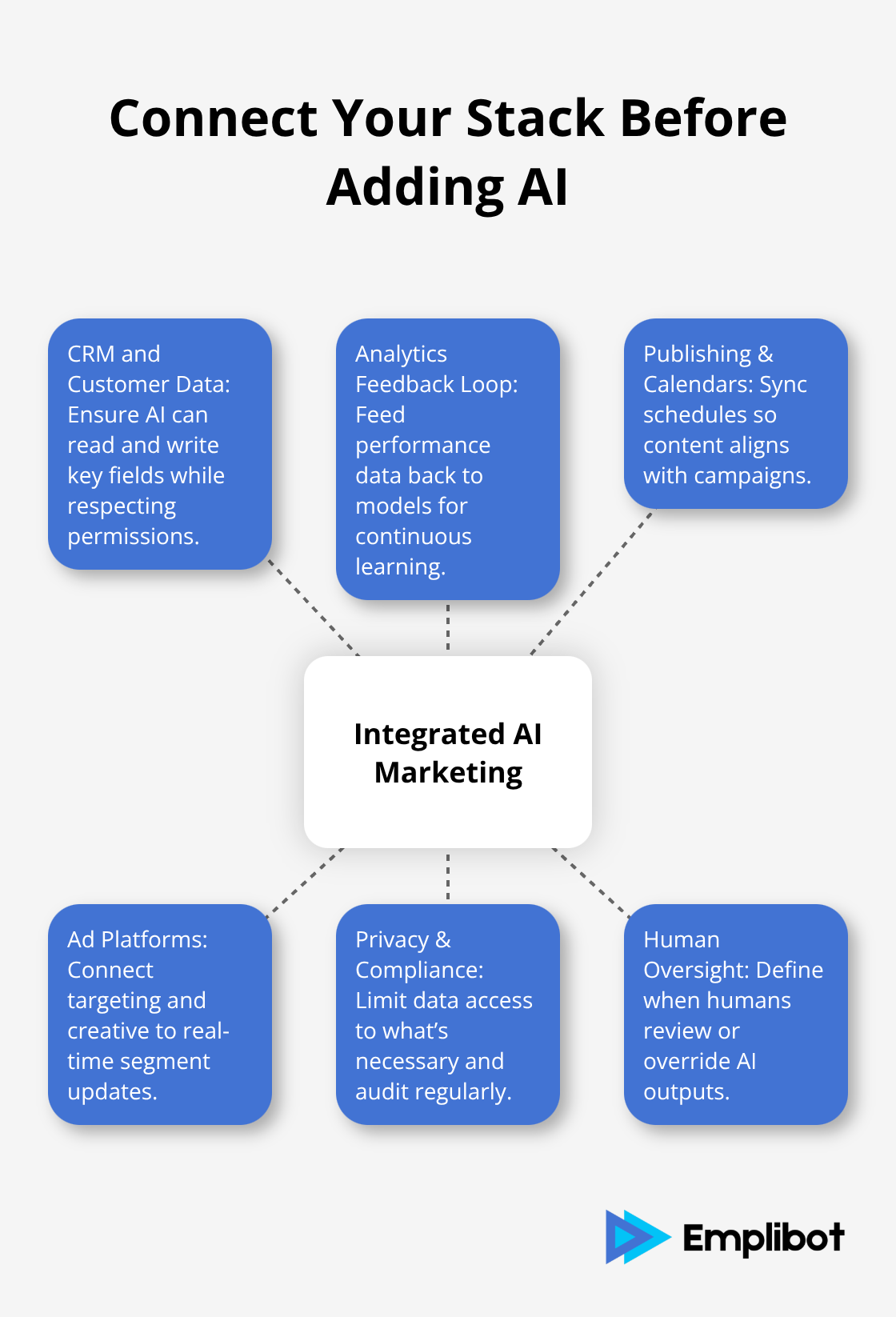
Then ask the AI vendor how it connects to those systems. If the answer is manual export-import or API connections that require developer time, calculate the real implementation cost. Integration complexity often costs more than the tool itself.
Your existing data infrastructure matters more than the flashiest new AI platform. A simple AI tool integrated with clean data will outperform an advanced system bolted onto a messy tech stack. This is why teams at companies like IBM saw 26x higher engagement-they trained their AI on clean, integrated data instead of hoping the tool would work magic on its own.
Data Quality Determines Whether AI Helps or Hurts
Poor data fed into an AI system produces poor outputs at scale, which means poor decisions affecting thousands of customers. If your customer segments are based on incomplete information, your AI personalization will send irrelevant messages to the wrong people. If your conversion data is inaccurate, your predictive models will optimize toward the wrong outcomes. Privacy violations compound the damage. When teams implement AI without reviewing how customer data flows through the system, they risk exposing sensitive information or violating regulations like GDPR.
Start with a data audit before you touch AI. Which customer fields are actually complete? Which ones are missing for 30% or more of your database? Where do you have duplicate records? Which data sources contradict each other? This unglamorous work determines your AI success rate more than any algorithm does. Once you’ve identified gaps, decide: do you clean the existing data or restrict AI to the fields where data is reliable? A.S. Watson’s 396% conversion lift came from using AI with high-quality behavioral data. They didn’t feed the system incomplete information and hope for the best. They made sure the data was accurate before the AI made recommendations.
Privacy also requires intentional system design. Document which customer data each AI tool accesses. Restrict access to what the tool actually needs. Audit regularly to catch data leaks before they become compliance violations. Teams that treat data quality and privacy as afterthoughts end up either scrapping their AI implementation or facing regulatory penalties. Teams that build these requirements into their process from day one see the results Verizon and IBM achieved-AI that actually improves customer experience instead of damaging it.
Final Thoughts
AI marketing tactics work when you build them on three foundations: clean data, human judgment, and integrated systems. The companies seeing real results aren’t using fancier tools than their competitors-they’re using the same platforms but implementing them correctly. They audit their data before deploying AI, keep humans in charge of brand voice and strategic decisions, and connect their tools so information flows instead of getting trapped in isolated systems.
Start with one high-impact workflow where you already have good data. If your email performance data is solid, test AI-generated subject lines; if your product descriptions are complete and accurate, deploy AI to generate variations and measure the lift against your baseline. Once you’ve proven the process works, expand to other areas-this approach takes longer than buying the flashiest new platform, but it actually produces results instead of expensive disappointment. Verizon prevented 100,000 customer churns by giving agents better AI-assisted guidance, not by removing agents from the equation, and that pattern holds across every successful implementation.
Your next step is auditing your current systems to identify which data is clean, which workflows waste the most time, and which customer experiences feel generic because you can’t personalize at scale. Pick one problem AI can solve with your existing data quality, implement it properly, and measure the results before you build from there. Emplibot automates your WordPress blog and social media by handling keyword research, content creation, and SEO optimization, which frees your team to focus on strategy and customer relationships instead of repetitive production work.